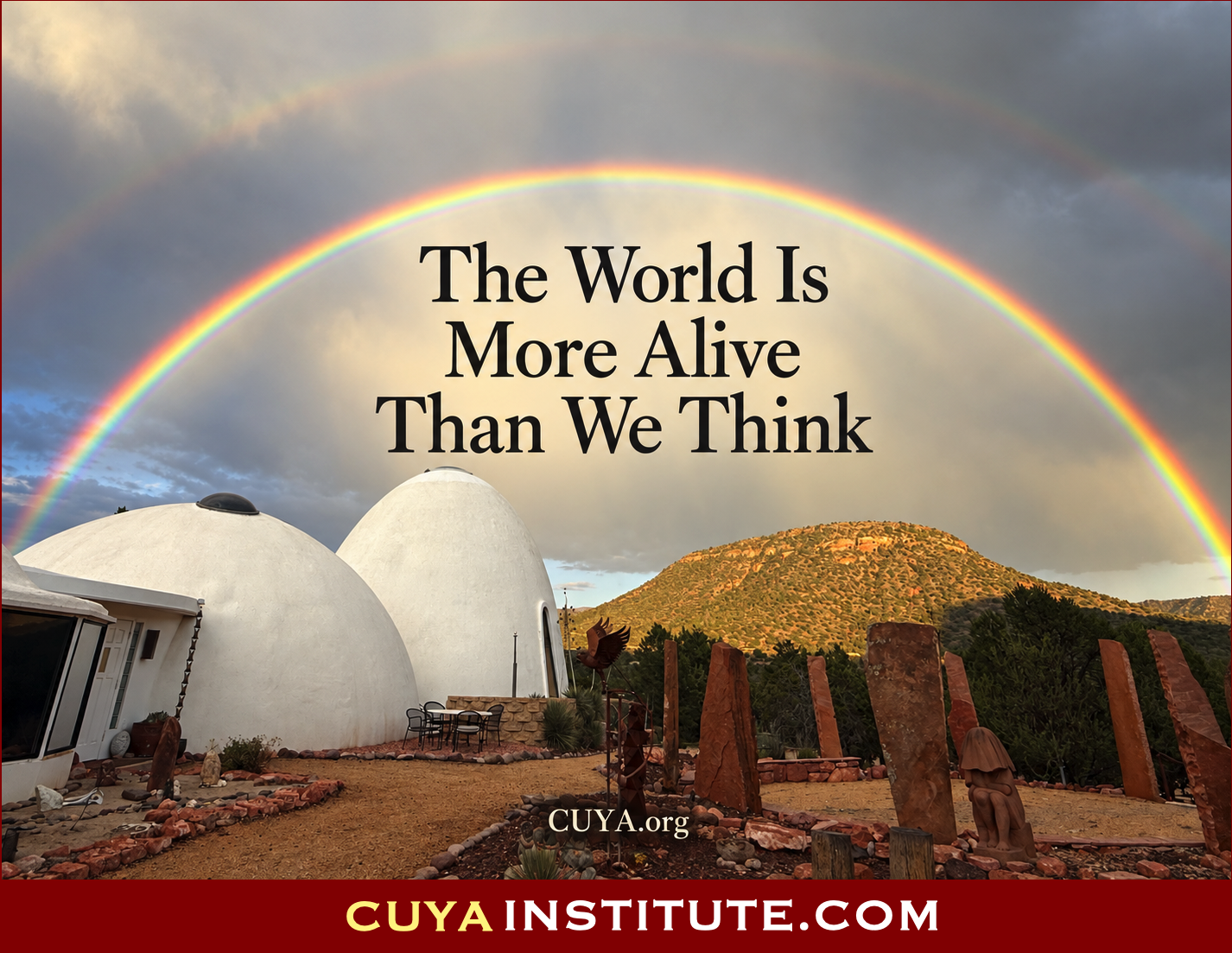
The night before last, an amazing rainbow appeared over the Megalithic Domes here in Sedona. Its broad arc reached across the sky above our home and the surrounding landscape. It gave me a moment to pause and appreciate the place where Laura and I live. That moment became an inspiration for this essay: how something happening in the natural world can draw us out of our thoughts and into a deeper feeling of connection.
There is an obvious difference between looking at the world and feeling that we belong to it. We can admire a landscape, identify its plants, learn its geology, and still experience ourselves as someone standing outside it. But I embrace those moments when that distance falls away. The wind moves across our skin, a bird calls, the light changes, and our attention settles into the place where we are. Something shifts. We begin to feel ourselves participating in the life around us.
Living here in Sedona, we have many opportunities to pay attention to that relationship. The red rocks are a familiar presence, yet the changing light keeps revealing something different. Being familiar with a place does not mean we have finished discovering it. When we slow down enough to notice, even an ordinary walk can become an encounter. I think this is part of what draws people into nature: the opportunity to feel connected to something larger than the concerns occupying our minds.
There is a deep human desire to belong, to know that our lives have meaning within a larger whole. We seek that connection through family, friendship, community, spiritual practice, and our relationship with the natural world.
Sometimes we describe it as a desire to connect with the universe. That can sound like an enormous undertaking, but it begins close to home. We are already breathing its air, drinking its water, and living within its rhythms. The connection exists. Our awareness of it can deepen.
Yet much of daily life encourages us to experience ourselves as separate. We move through schedules, screens, responsibilities, and the running commentary in our own heads. The world becomes a backdrop to whatever we are trying to accomplish. A tree provides shade. A landscape offers a view. A season brings weather we welcome or resist. It is easy to lose our curiosity about the life unfolding around us when our attention stays fixed on what it can do for us.
What changes when we approach the world as a relationship?
We know something about this from our relationships with people. Knowing facts about someone is different from spending time with them, listening, and allowing ourselves to be affected by their presence. A relationship develops through attention and participation. I think our connection with place can grow in a similar way. We begin to recognize the sounds of a particular morning, the movement of water after rain, the return of certain birds, or the way the land changes through the seasons. Familiarity becomes a form of care.
I am also reminded that everything in existence is alive, conscious, and possesses a spiritual essence or relation to creation. There is no strict division between the natural and the spiritual realms. As we explore Indigenous perspectives and ancient cosmologies, I want to make room for the particular peoples, places, and traditions behind them. Each deserves attention on its own terms. For me, the invitation begins with a question we can bring to our own lives: What have we stopped noticing, and what would become possible if we learned to pay attention again?
Practices such as mindfulness meditation give us a place to begin. We sit, breathe, and notice what is happening. As attention settles, we can become more aware of how thoroughly we are involved with our surroundings. The sense of being an isolated observer can soften. We are here, within the experience.
This is also a significant part of what we explore through Ritual Postures. We begin with the body: a specific position and rhythmic sound. From there, awareness can move beyond its familiar organization around our name, our history, and our immediate concerns. The body becomes a means of entering a larger field of experience.
Within these experiences, a participant may encounter an animal, a landscape, an ancestor, or a presence experienced as spirit. At other times, the experience centers on a feeling of belonging, shared vitality, or connection with life itself. What interests me is how these encounters can change the quality of a person’s relationship with the world. Something that had been distant or abstract becomes personally meaningful.
When someone describes feeling at one with the universe, I hear an attempt to put a profound experience into ordinary language. The familiar boundary around the individual self has shifted. There can be a sense of participating in something immense, alive, and shared. Words such as “oneness” and “energy” help people communicate the feeling, even when the experience exceeds what those words can explain.
Connection also asks something of us. If we feel that we belong to a place, its well-being becomes part of our concern. If we experience community as a source of strength, we have a reason to contribute to it. Gratitude can become an action: tending, helping, protecting, or making time to be present. A sense of relationship grows through what we give as well as what we receive.
The rhythms of nature offer another way to understand balance. There are periods of growth and rest, abundance and scarcity, emergence and decline. We live within these cycles while often expecting ourselves to remain equally productive, available, and energetic every day. Paying attention to the natural world can bring us back to questions about our own rhythms. When do we need to act? When do we need to rest? What needs tending, and what is ready to be released?
For me, harmony is an ongoing practice of noticing and responding. We lose our balance, recognize it, and make an adjustment. We return to the people, places, and practices that help us remember what matters. Ritual can support that return by giving our attention a clear purpose and inviting our whole body into the process.
This is one reason I think our work at the CUYA Institute reaches beyond the time spent holding a posture. The practice invites us to reconsider our place in the world. An experience of connection can awaken a desire to learn, to listen, and to live with greater care. It can give us a renewed sense that our lives have meaning within relationships extending far beyond ourselves.
The world is more alive than we think. I mean that as an invitation to discovery. There is more happening around us than our habits of attention allow us to notice, and more available within relationship than we can learn from a distance. We can begin with the next breath, the next walk, or the next moment when we give another living being our full attention. From there, a larger conversation can begin.



 As a 501(c)(3) nonprofit educational organization, we depend on your support to continue our work. We invite you to join our community and be part of this ongoing journey of exploration and discovery. more….
 The name “CUYA” carries with it both history and vision. Rooted in our origins as the Cuyamungue Institute, it now also serves as an acronym — C.U.Y.A. — a guiding symbol that unites our mission: