
Awakening the Sacred Through the Elements
Author – Paul Robear ©2025
The act of ritual is a common thread that has linked humanity across millennia, transcending culture, geography, and belief. It is believed that the oldest known evidence of ritual dates back over 70,000 years, to the Tsodilo Hills of Botswana, a site the local people call the Mountains of the Gods. I often think of those early humans gathered around the fire, their movements and offerings expressing reverence and belonging. Ritual was how they found kinship—with one another, with the earth beneath their feet, and with the vast unseen world that surrounded them.
At its essence, ritual helps us set the stage to step out of the ordinary and open the door to an expanded state of awareness. As Dr. Felicitas Goodman observed in her cross-cultural research, all traditional societies employ ritual as the threshold between worlds. Through this threshold we orient ourselves toward the sacred. One of the most universal and enduring of these preparatory steps is purification.
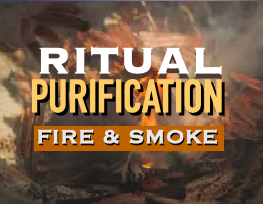
At the Institute, we begin each session by aligning both body and mind toward sacred awareness. One of the most direct and symbolic ways to do this is through the elements—fire and smoke. These are ancient allies that have accompanied humanity since the dawn of time.
We often burn a few leaves of sage as a way of cleansing and centering, a practice known as smudging. While most commonly associated with Native American traditions of the Southwest, variations of smoke cleansing are found throughout the world. The act of passing smoke over the body or through a space carries a universal language of purification, releasing stagnant energy and inviting clarity, harmony, and presence.
When I hold the burning sage and watch the smoke curl upward, I feel connected to a lineage that stretches far beyond time. It is not merely symbolic; it feels like a conversation between earth and sky, a visible breath of prayer.
Fire is one of humanity’s oldest teachers. In every culture, fire rituals mark transformation, renewal, and rebirth. Whether lighting a candle or tending a ceremonial blaze, we participate in a dialogue with the element that transforms matter into light and heat—and metaphorically, ignorance into insight.
To me, lighting the ritual fire is an act of intention. The flame becomes a mirror of the inner life, burning away distraction, purifying thought, and illuminating purpose. It invites us to begin again, renewed. A fire ceremony connects us to ancestral wisdom, reminding us that even as flames consume, they also give life.
Smoke is the visible spirit of fire. It carries our prayers upward, bridging the earthly and the divine. Across countless cultures, smoke offerings symbolize transformation, gratitude, and communication with the unseen world. In Native pipe ceremonies, the smoke carries prayers to the Creator. In Aboriginal smoking ceremonies of Australia, fragrant leaves are burned to cleanse, protect, and honor the land and ancestors. In Buddhist temples, the goma taki fire ritual transforms written prayers into ash, symbolizing release and transcendence.
Each of these traditions echoes the same impulse: to connect through transformation. As the smoke rises, so too does our consciousness, expanding awareness and inviting presence.
The Vedic Agni Hotra fire ceremony in India is seen as a direct invocation of the divine, its rising smoke mirroring the ascent of kundalini energy uniting earth and sky. The Aboriginal smoking ceremony uses the fragrant leaves of eucalyptus and emu bush to cleanse and bless, reminding participants of their bond with the land. In Buddhist temples, daily fire rituals transform written prayers into light, symbolizing the burning away of illusion. The ancient Aztec New Fire Ceremony, held every 52 years, marked the renewal of cosmic time when the world’s fires were extinguished and rekindled to begin anew.
When we speak of ritual within the practice of Ritual Postures, we are entering into a process that reaches deep into the roots of humanity itself. For me, the ritual framework surrounding the practice is not merely preparation—it is participation in something timeless. Each gesture, each act of intention, connects us with an ancient lineage of those who sought the sacred fire within through the language of body, breath, and spirit.
Reflection. As I stand before the flame and watch the smoke rise, I am reminded that purification is not only about cleansing space but about clearing the inner landscape. Ritual invites us to return to what is essential, to remember our place in the greater rhythm of life. The elements of fire and smoke teach that transformation is constant, and that through awareness, we too can be renewed. In this way, the ancient language of ritual continues to speak—calling us to presence, reverence, and the ever-living connection between the human and the sacred.
“The ritual fire connects us to an ancient lineage of those who sought the sacred through the language of body, breath, and spirit.” - Paul Robear
Paul Robear Tweet
The name “CUYA” carries with it both history and vision. Rooted in our origins as the Cuyamungue Institute, it now also serves as an acronym — C.U.Y.A. — a guiding symbol that unites our mission:
C — Consciousness: The field of shared awareness that arises in Collective Presence, where the “We” awakens beyond the “I” – moving from the “Me to the We.”
U — Unity: Our alignment with the Cycles of Nature and the rhythms of the cosmos, reminding us that we are woven into a greater fabric of reality. This sense of unity reminds us that our awareness is the shared consciousness that connects all living beings.
Y — Your Awakening: The inner journey of Embodiment and Wisdom, where through direct experience the body remembers. At the CUYA Institute, this awakening is nurtured through Ritual Body Postures and ecstatic trance, where the body itself becomes the doorway to wisdom, presence, and transformation.
A — Ancestral Wisdom: Roots. Our connection to Sacred Lineage, honoring those who walked before us and rooting us in belonging and continuity. Our founder, anthropologist Felicitas D. Goodman looked to some of the oldest, most authentic ancestral records we have — the world’s collection of early and indigenous art — and decoded selected artifacts as embodied “ritual instructions.”
Together, the Four Pathways of C.U.Y.A. — Consciousness, Unity, Your Awakening, and Ancestral Wisdom — form a single tapestry of practice. They remind us that awakening is not an abstract idea but something we live: through the body in Your Awakening, through nature’s cycles in Unity, through community in shared Consciousness, and through the guidance of Ancestral Wisdom.