


Moving Spirituality Out of the Head and Back Into the Body
Author – Paul Robear ©2025
I think sometimes in modern spirituality there is a subtle habit of using words like “grounding,” “centering,” or “being present,” while remaining almost entirely in the realm of thought. Embodiment becomes poetic language rather than lived reality. We talk about the body — but do we actually inhabit it? The result can be a spirituality that is articulate, insightful, and even inspiring — yet strangely unrooted.
Embodiment is not an idea. It is a sensory event. It begins by moving spirituality out of the head and back into the bone.
In contemporary culture, I’ve noticed spirituality is often overshadowed by the intellect. We are encouraged to read books about presence. We can have deep conversations about compassion. We analyze consciousness. Yet this very activity can become a subtle distraction. True transformation is not an idea you agree with; it is a physiological shift. To be embodied is to feel the temperature of the air on the skin, the weight of the feet against the floor, the rhythm of breath expanding the ribs, and the subtle emotional tones living quietly in the chest and belly. It is to experience awareness as distributed throughout the whole organism rather than confined to the mind. When spirituality returns to the body, it becomes less about belief and more about perception.
Many spiritual traditions emphasize transcendence — rising above the material, surpassing the ego, or reaching higher states of consciousness. I deeply respect this aspiration. But we must be cautious of an unintended side effect: disconnection from the physical self. The irony is that expanded awareness is often found not by escaping the body, but by entering it more fully. The body is not an obstacle to consciousness; it is an instrument of it.
When attention drops from the forehead into the torso, from narrative into sensation, something shifts. Thoughts lose their dominance. Awareness becomes spacious without effort. Breath deepens. The nervous system recalibrates. Presence stops being something we attempt and becomes something we inhabit.
Posture is not merely structural — it is perceptual. The alignment of the spine, the openness of the chest, the position of the head subtly influence emotion, receptivity, and clarity. Breath regulates the nervous system in real time. Sensation provides immediate feedback about safety, contraction, openness, or resistance. A tightened jaw can maintain defensiveness. A softened belly can allow vulnerability. A grounded stance can evoke confidence without a single affirming thought. These are not metaphors. They are lived shifts in perception.
Embodiment reminds us that insight is not solely cognitive. Wisdom can arise from the soles of the feet as much as from the intellect. The body holds memory, intuition, and symbolic intelligence in ways language cannot fully capture.
Our culture rewards speed, abstraction, and productivity. Screens mediate communication. Information is constant. The body becomes something we transport rather than inhabit — a vehicle for the brain instead of a participant in experience. Over time, we learn to override physical cues: ignore fatigue, suppress emotion, sit still despite tension, push through discomfort. Disembodiment becomes normalized.
Reclaiming embodiment is therefore both personal and cultural. It is a quiet act of resistance against fragmentation — a decision to experience life from the inside rather than observing it from a mental distance.
Embodied awareness is not dramatic. It is immediate. A facilitator pauses before speaking, feels their feet, allows a full exhale — and the tone of the room softens. In conflict, someone relaxes their shoulders and unclenches their jaw, and listening becomes possible where defensiveness once lived. During a contemplative practice, even a subtle shift in posture can evoke a profound change in perception — not because of belief, but because the body reorganizes awareness.
In our own work with Ritual Postures, we see this repeatedly. A precise alignment of spine, arms, and breath — drawn from ancient imagery — can alter consciousness without a single word of instruction. Participants often describe expanded states not as something imagined, but as something entered through the body itself. The posture does not symbolize transformation; it generates it.
“Our practice of Ritual Body Postures is a physiologically based practice –
it does not require a belief system.”
– Dr Felicitas D. Goodman, Founder of the Cuyamugue Institute
Embodiment is about remembering that awareness is not confined to the skull. The body is not a symbolic accessory to spiritual life; it is the ground from which spiritual perception arises. When we return to sensation — to breath, weight, tension, and release — spirituality becomes less about striving and more about inhabiting.
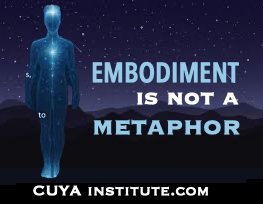
Embodiment is not a metaphor because the body is not an idea.
It is where experience actually happens.
“Embodiment is not an idea you agree with; it is a physiological shift.” - Paul Robear
Paul Robear Tweet
The name “CUYA” carries with it both history and vision. Rooted in our origins as the Cuyamungue Institute, it now also serves as an acronym — C.U.Y.A. — a guiding symbol that unites our mission:
C — Consciousness: The field of shared awareness that arises in Collective Presence, where the “We” awakens beyond the “I” – moving from the “Me to the We.”
U — Unity: Our alignment with the Cycles of Nature and the rhythms of the cosmos, reminding us that we are woven into a greater fabric of reality. This sense of unity reminds us that our awareness is the shared consciousness that connects all living beings.
Y — Your Awakening: The inner journey of Embodiment and Wisdom, where through direct experience the body remembers. At the CUYA Institute, this awakening is nurtured through Ritual Body Postures and ecstatic trance, where the body itself becomes the doorway to wisdom, presence, and transformation.
A — Ancestral Wisdom: Roots. Our connection to Sacred Lineage, honoring those who walked before us and rooting us in belonging and continuity. Our founder, anthropologist Felicitas D. Goodman looked to some of the oldest, most authentic ancestral records we have — the world’s collection of early and indigenous art — and decoded selected artifacts as embodied “ritual instructions.”
Together, the Four Pathways of C.U.Y.A. — Consciousness, Unity, Your Awakening, and Ancestral Wisdom — form a single tapestry of practice. They remind us that awakening is not an abstract idea but something we live: through the body in Your Awakening, through nature’s cycles in Unity, through community in shared Consciousness, and through the guidance of Ancestral Wisdom.