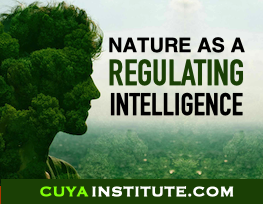


How the body returns to balance through rhythm, cycles, and environmental coherence
Author – Paul Robear ©2026
Have you ever noticed that in certain natural environments your body begins to change before your thoughts do?
For me, my breathing deepens and something in my system settles – often before I’ve even fully registered where I am.
It’s not something I’m doing consciously. In fact, it seems to happen more fully when I’m not trying at all.
I’ve come to feel that it goes beyond the idea that nature helps us relax. It’s that our bodies are responding to something – something deeply organized, consistent, and connected to a quiet intelligence.
It’s easy to say that nature is calming, but that doesn’t quite capture what is happening. What I’ve come to feel is that nature is not simply soothing… it is regulating. It carries a kind of inherent intelligence, a living order that the body recognizes and responds to without needing instruction.
We often think of going into nature as a way to get away – from stress, from technology, from the pace of daily life. And while there is truth in that, the shift we feel is not just about leaving something behind. It is about entering into something – a field where rhythm, pacing, and relationship are already established.
In that environment, the body doesn’t seem to have to work as hard to organize itself. It begins to settle, not because it has been told to, but because it is no longer surrounded by the same degree of fragmentation.
This brings us to what may be one of the most powerful aspects of the natural world: rhythm. We see it in the steady rise and fall of light across the day, the turning of seasons, and the movement of wind or water. These are not just patterns we observe, but patterns we begin to entrain to. Our breath mirrors what is around us. Our internal pace slows or steadies. Awareness shifts from urgency to a sense of continuity.
Rhythm, in this sense, is not something we impose. It is something we receive.
From this perspective, nature acts as a regulating intelligence by helping to reset the human nervous system through cycles and sensory simplicity. It reduces mental strain, softens reactivity, and shifts awareness from a state of constant demand toward one of restoration and connection.
In modern environments, stimulation is often sharp, fast, and demanding – sounds that call for attention, constant input that requires interpretation. In natural settings, there may be fewer inputs, but they are richer. Textures are organic, sounds are layered but not intrusive, and nothing is asking to be decoded.
As that demand eases, the mind begins to soften its grip. The constant filtering and categorizing relax, and awareness opens. We begin to notice more, not because there is more to process, but because there is less resistance in the system.
What feels most significant is that none of this is new. There is a sense that the body already knows how to be here. It doesn’t have to learn how to slow down or attune – it remembers. Something ancient responds to the living world as if returning to a familiar language.
In this way, being in nature can feel less like an experience we are having and more like a remembering we are entering into. The body doesn’t strive in that space. It entrains.
Over time, I’ve come to feel that nature is not simply a place we go, or a backdrop for reflection. It is a field of intelligence that we step into – a relational space where our internal state is continuously interacting with something much larger. When we begin to sense that, even faintly, the experience shifts. We are no longer just observing. We are participating.
Most of us, of course, return to the rhythms and demands of daily life. But the question that lingers is whether the relationship has to end when we leave. If the body can recognize and entrain to coherence, it may also begin to carry that imprint forward – through attention, through breath, and through a quiet remembering of rhythm.
In our work with Ritual Body Postures, we’ve found that the body itself can become a way of returning to this same kind of internal regulation. Without relying on an external environment, posture and stillness can help reawaken those underlying rhythms – as if the body remembers not only that it can entrain, but how.
Nature, then, is not only something we visit. It becomes something we remain in relationship with – a subtle, regulating presence that continues to inform how we move, perceive, and inhabit our lives.
What I’ve come to feel is that nature is not simply soothing... it is regulating. It carries a kind of inherent intelligence.
Paul Robear Tweet
The name “CUYA” carries with it both history and vision. Rooted in our origins as the Cuyamungue Institute, it now also serves as an acronym — C.U.Y.A. — a guiding symbol that unites our mission:
C — Consciousness: The field of shared awareness that arises in Collective Presence, where the “We” awakens beyond the “I” – moving from the “Me to the We.”
U — Unity: Our alignment with the Cycles of Nature and the rhythms of the cosmos, reminding us that we are woven into a greater fabric of reality. This sense of unity reminds us that our awareness is the shared consciousness that connects all living beings.
Y — Your Awakening: The inner journey of Embodiment and Wisdom, where through direct experience the body remembers. At the CUYA Institute, this awakening is nurtured through Ritual Body Postures and ecstatic trance, where the body itself becomes the doorway to wisdom, presence, and transformation.
A — Ancestral Wisdom: Roots. Our connection to Sacred Lineage, honoring those who walked before us and rooting us in belonging and continuity. Our founder, anthropologist Felicitas D. Goodman looked to some of the oldest, most authentic ancestral records we have — the world’s collection of early and indigenous art — and decoded selected artifacts as embodied “ritual instructions.”
Together, the Four Pathways of C.U.Y.A. — Consciousness, Unity, Your Awakening, and Ancestral Wisdom — form a single tapestry of practice. They remind us that awakening is not an abstract idea but something we live: through the body in Your Awakening, through nature’s cycles in Unity, through community in shared Consciousness, and through the guidance of Ancestral Wisdom.