
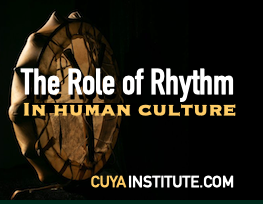


Over the years I have become increasingly aware of how quickly rhythm can change the atmosphere of a gathering. I traditionally begin with drumming as an invitation to start the ritual — a simple way to encourage a shift of energy. Something begins to change in the room. Conversations fade, attention gathers, and the group gradually settles as the rhythm begins to organize a quiet coherence. Watching this happen again and again has convinced me that rhythm plays a deeper role in human experience than we often recognize.
I propose that before language organized human thought, rhythm organized human experience. The earliest shared patterns of attention were not written or spoken — they were heard and felt. Across cultures, rhythm shaped how communities gathered, moved, and entered altered states of awareness. The steady pulse of a drum, the cadence of footsteps, and the rise and fall of collective breath drew people into a common tempo.
It seems we have always gathered in rhythm.
Archaeological evidence suggests that rhythmic instruments appeared early in human history. Ancient drums, rattles, and bone flutes have been discovered in prehistoric sites. In many cases these instruments were used within ritual contexts, accompanying dance, chant, and communal ceremonies.
The persistence of rhythm across cultures suggests that it serves a deeper human function.
It stirs from within. The body itself is rhythmic. The heart beats in pulses. Breath rises and falls. Brain activity moves in oscillating patterns. In this sense, rhythm is not something external to the body — it is one of the fundamental languages through which the body operates.
When external rhythms appear, the nervous system tends to synchronize with them. Attention stabilizes. The mind begins to organize around the pattern.
Observing this again and again, it became clear that something more than simple rhythm was taking place. Scientists describe this phenomenon as entrainment — the tendency of biological systems to align with rhythmic signals in their environment. Much like pendulums placed near one another eventually synchronize, human physiology gradually begins to align with external rhythmic patterns. For me, this serves as some of the best evidence supporting embodied spirituality.
Traditional cultures appear to have understood this intuitively. In many ceremonial traditions, rhythmic sound is used at the beginning of ritual practice. The steady pulse of a drum or rattle gradually gathers the attention of participants. Individuals who arrive with scattered thoughts begin to settle into a shared tempo.
Rhythm creates a bridge between individual and collective experience.
When people move or breathe together in rhythm, a subtle form of cohesion begins to emerge. Attention stabilizes, movement synchronizes, and the group begins to experience itself as a unified field rather than a collection of separate individuals.
This may be one reason that rhythm appears in so many forms of collective practice: drumming circles, chanting in monasteries, communal dance, and even modern concerts. In each case, rhythm organizes attention and coordinates bodies in time.
In earlier societies, this function may have been essential. Human survival often depended on cooperation within groups. Rhythmic activities such as communal dance or ritual movement helped strengthen bonds and reinforce shared identity.
Rhythm, in this sense, may be one of humanity’s oldest social technologies.
Across traditions, rhythm often prepares the ground for deeper states of awareness.
Before symbolic meaning or visionary imagery emerges in ritual settings, the body must first settle into a state of coherence. Rhythm provides a reliable pathway for this transition.
Within the practice of Ritual Postures, rhythmic sound induction serves a similar role. Participants enter a specific posture derived from traditional iconography while a steady pattern of rattling or drumming is played. The rhythmic sound provides a consistent auditory environment that helps organize attention and stabilize awareness.
Over time, participants often report that the outer world begins to recede slightly. Attention shifts inward, and imagery, emotion, or insight may begin to emerge.
The rhythm itself does not cause the experience. Rather, it helps create conditions in which the mind can settle and become receptive to deeper layers of perception.
Rhythmic practices offer a simple counterbalance to the fragmented patterns of modern life. The predictability of rhythm reduces the effort required to maintain attention. The nervous system can relax into the pattern rather than constantly scanning for new stimuli.
This may help explain why rhythmic practices continue to reappear in modern culture. Drumming circles, chanting groups, breathwork gatherings, and movement practices are increasingly popular. Even when separated from their traditional cultural frameworks, people still respond to the organizing power of rhythm.
Something in the body recognizes it.
Rhythm reminds us that attention does not always need to be forced or controlled. Sometimes it only needs a pattern strong enough to follow.
In a world where attention is increasingly fragmented, this ancient human capacity may once again become important.
The future of ritual practice may not depend solely on new ideas or reinterpretations of tradition. It may also depend on remembering the basic elements that have always supported human awareness: breath, posture, rhythm, and shared presence.
These are not relics of the past. They are enduring tools for organizing the human mind.
And among them, rhythm may remain one of the most powerful.
“Before language organized human thought, rhythm organized human experience.” - Paul Robear
Paul Robear Tweet
The name “CUYA” carries with it both history and vision. Rooted in our origins as the Cuyamungue Institute, it now also serves as an acronym — C.U.Y.A. — a guiding symbol that unites our mission:
C — Consciousness: The field of shared awareness that arises in Collective Presence, where the “We” awakens beyond the “I” – moving from the “Me to the We.”
U — Unity: Our alignment with the Cycles of Nature and the rhythms of the cosmos, reminding us that we are woven into a greater fabric of reality. This sense of unity reminds us that our awareness is the shared consciousness that connects all living beings.
Y — Your Awakening: The inner journey of Embodiment and Wisdom, where through direct experience the body remembers. At the CUYA Institute, this awakening is nurtured through Ritual Body Postures and ecstatic trance, where the body itself becomes the doorway to wisdom, presence, and transformation.
A — Ancestral Wisdom: Roots. Our connection to Sacred Lineage, honoring those who walked before us and rooting us in belonging and continuity. Our founder, anthropologist Felicitas D. Goodman looked to some of the oldest, most authentic ancestral records we have — the world’s collection of early and indigenous art — and decoded selected artifacts as embodied “ritual instructions.”
Together, the Four Pathways of C.U.Y.A. — Consciousness, Unity, Your Awakening, and Ancestral Wisdom — form a single tapestry of practice. They remind us that awakening is not an abstract idea but something we live: through the body in Your Awakening, through nature’s cycles in Unity, through community in shared Consciousness, and through the guidance of Ancestral Wisdom.