No matter where our travels take us, Laura and I always look for archaeological museums. As we walk through the exhibits, we enjoy discovering the details—what an object is made from, where it was discovered, how old it is, and what culture produced it. We may learn something about the people who created it, the tools they used, the food they ate, the houses they built, and the gods they worshipped. But our curiosity usually takes us one step further. Part of the mission of this Institute is to ask another question: What did these people experience?
What happened within the community when people entered their ceremonial spaces, made offerings, danced, chanted, drummed, fasted, prayed, or positioned their bodies in particular ways? What did they feel and perceive? Did their religions, beliefs, and rituals change their experience of themselves and the world around them? Did they encounter ancestors, spirits, animals, gods, visions, or other realities that were as meaningful to them as the ordinary world of everyday life? These questions lead into what I think of as the archaeology of human experience.
Traditional archaeology is amazing at rebuilding stories from material evidence. A broken vessel, a burial, a figurine, a temple foundation, a painted cave wall, or a carved stone survives while the experience of the person who made or used it seems to disappear. The artifact remains, but the human moment behind it is much harder to recover. What interests Laura and me is the possibility that some ancient objects preserve something of the spiritual cosmology of the people who created them. We think they contain clues about how people deliberately created particular kinds of human experience.
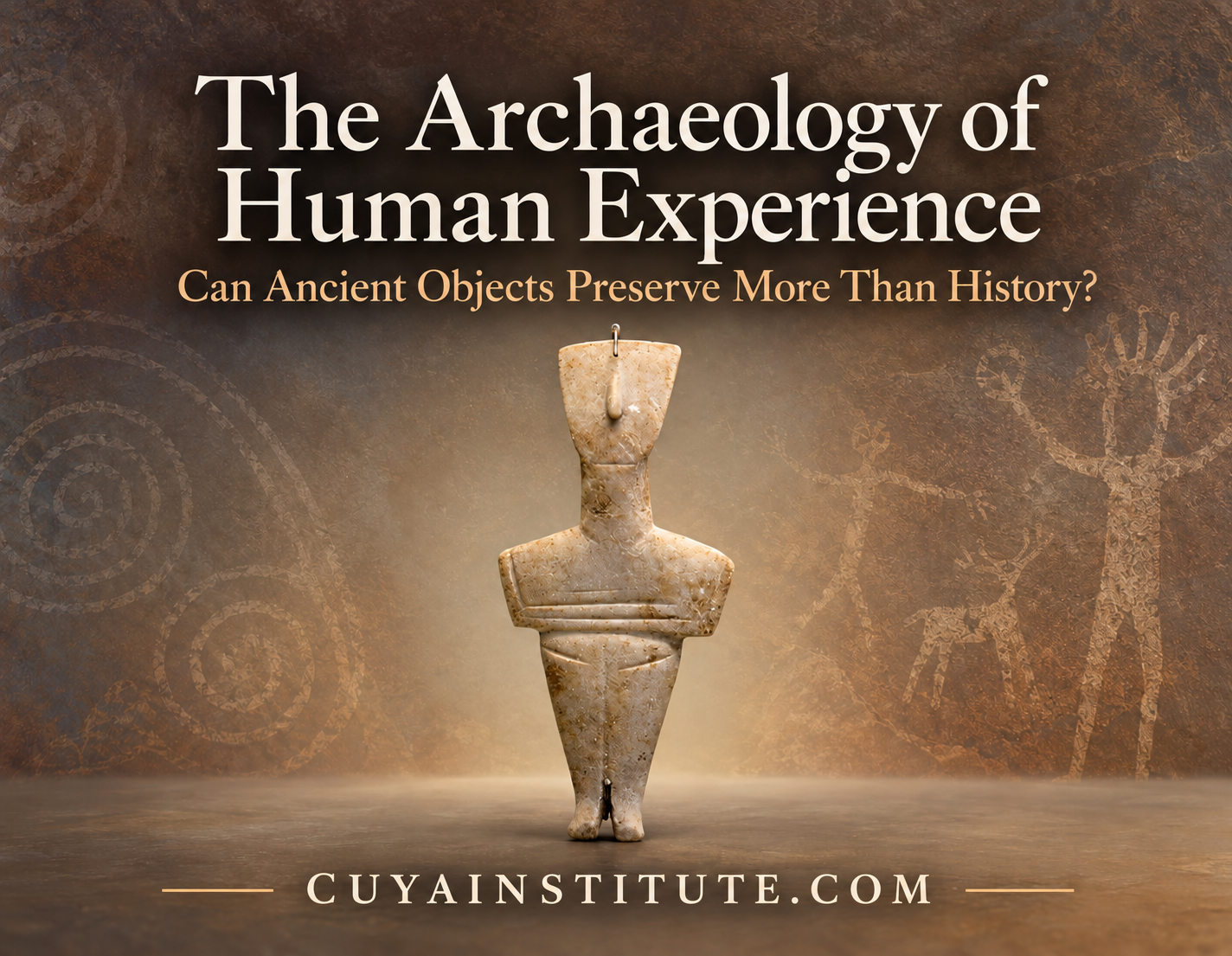
This becomes especially intriguing when we look at representations of human figures. Across cultures and thousands of years, people created figurines, sculptures, carvings, paintings, and ceremonial objects depicting human beings in very specific positions. Arms cross the chest. Hands rest on particular parts of the body. Fists are held in unusual orientations. Heads tilt backward. Legs are positioned asymmetrically. Bodies kneel, squat, stand, recline, or sit in ways that appear very deliberate.
For the last 35 years, Laura and I have been working with CUYA—the Cuyamungue Institute—and these ancient bodily representations have been at the center of a remarkable question: What happens when a living human body assumes the position preserved in an ancient artifact?
That question originated in the pioneering work of anthropologist Dr. Felicitas D. Goodman. Goodman discovered that certain bodily positions represented in ancient art could have a striking influence on experiences occurring during a particular physiological shift in consciousness. Rather than looking at an ancient figurine only as an object to be interpreted, she began treating the posture itself as something that could be investigated.
I think that distinction is fundamental to our work. Instead of asking only, What does this artifact mean?, we also ask, Why this body position, and what does this posture do? That changes the nature of the question. An archaeological object is normally placed in front of us. We observe it, measure it, date it, and construct interpretations from the evidence available to us. Ritual Posture practice introduces another possibility. The body represented by the artifact is reconstructed through our own body by holding the position indicated. The artifact is no longer only something we look at. It becomes ritual instructions.
I find this fascinating because the human body provides an extraordinary point of continuity between ourselves and the people of the ancient world. Cultures change. Languages disappear. Religions rise and fall. Civilizations develop and vanish. Meanings attached to symbols can be forgotten completely. Yet the basic human organism remains remarkably familiar.
Ancient people breathed. Their hearts accelerated and slowed. Their muscles held tension. Their nervous systems responded to rhythm, movement, fear, expectation, community, darkness, sound, and silence. They dreamed and experienced altered states. They felt awe, fear, love, grief, wonder, and connection. Their cultures shaped how they understood and described these experiences, but the instrument through which those experiences occurred was the human body. We still possess that instrument.
This is why I think embodied investigation deserves a place alongside our intellectual study of ancient ritual. I am not suggesting that assuming the posture of a 6,000-year-old figurine tells us exactly what the person who created it believed. We don’t know that. We cannot interview the artist or reconstruct every element of the original ritual setting. But we can assume the position of the body that was preserved, recreate certain conditions associated with ritual experience, and observe what happens. That is exactly what our research has been documenting.
At the CUYA Institute, Laura and I are exploring how the human body can help us investigate dimensions of ancient ritual experience that material analysis alone cannot reach. In our sessions, participants assume a carefully reconstructed Ritual Posture while rhythmic sound supports a normal physiological shift into an expanded state of consciousness. Afterwards, people describe their experiences in their own words. We listen, document, and compare experiences over time. And what we see are patterns.
One person may describe an animal while another describes movement underground. Someone else may experience protection, healing, flight, transformation, water, death and rebirth, or an encounter with an intelligence that seems to exist outside the ordinary self. Participants use different language and have their own individual journeys, but recognizable themes frequently emerge across a group. We call these synchronicities, and they are one of the most interesting aspects of this work.
The significance is not that everyone has the same vision. They don’t, and I would be suspicious if they did. Human experience is much richer and more individual than that. What interests us are the points of convergence—the qualities, images, movements, sensations, and themes that arise independently among people having their own experiences.
This has led me to look at ancient bodily representations differently. We have found that many function not simply as images, but as technologies of experience. We usually think of technology as something external to ourselves. But humans have also developed technologies that require very little material equipment because the primary instrument is the human body.
From this perspective, an ancient figurine depicting a highly specific bodily position can be viewed as more than an artistic representation. I suggest that in some cases we have found that it preserves part of a procedure, a form of encoded information about something that was meant to be experienced.
The archaeological record, viewed this way, becomes more than a record of things. It becomes a record of relationships between body, environment, ritual, and consciousness.
It also asks us to reconsider what we mean when we talk about ancestral knowledge. Knowledge does not have to be written down to survive. It can be carried in stories, songs, movements, ceremonies, images, and bodily practices. A culture can encode something it knows without ever turning that knowledge into a written explanation.
This is why the study of consciousness belongs in our conversation about the ancient human past. If altered and expanded states of consciousness have been part of human life for thousands of years, then leaving experience out of our interpretation of ancient ritual leaves out an important part of the human story.
The people who made these objects cannot speak to us directly, and much of their world is lost to us. But they left traces: a hand position, a tilted head, a painted figure, a carved body, a chamber built into the earth, a place where people gathered again and again.
I think we should put less emphasis on only what these things represented. I think we should also ask why people created them in the first place and what kinds of experiences may be encoded in these creations. That is the archaeology of human experience.
Our ancestors had experiences. Those experiences influenced their ceremonies, their stories, their art, their communities, and their understanding of reality. If we want to understand something of the fullness of ancient human life, then we need to remain curious not only about the objects people left behind, but about the states of consciousness and ways of knowing that gave those objects meaning.
At the CUYA Institute, this question sits at the heart of our work. We study the artifact and what we know about the culture that produced it. We reconstruct the posture as carefully as we can. We document what happens when people experience it, and we look for patterns without trying to force an explanation onto them. And then we do something that is both very simple and, to me, quite extraordinary: we use the human body as a way of asking questions about human experience.
The artifact has survived for thousands of years. The human body has survived with it. What we are exploring is what happens when we bring the two back together.



 As a 501(c)(3) nonprofit educational organization, we depend on your support to continue our work. We invite you to join our community and be part of this ongoing journey of exploration and discovery. more….
 The name “CUYA” carries with it both history and vision. Rooted in our origins as the Cuyamungue Institute, it now also serves as an acronym — C.U.Y.A. — a guiding symbol that unites our mission: