
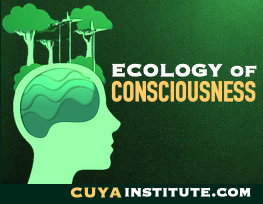


The Inner Landscape Shapes Our Collective Life
Author – Paul Robear ©2025
When we speak about the environment, it is most often something out in the world around us – forests, oceans, climate systems, fragile ecosystems. Yet I’ve come to reflect on another ecology unfolding all the time, one that also surrounds and includes us — the ecology of consciousness.
I love this parallel as a reminder that the sacred is both internal and external. Just as the natural world is made up of interdependent systems, our inner world is also a living network. Our thoughts, emotions, sensations, beliefs, and memories interact continuously. Nothing arises in isolation. We have all experienced how a single anxious thought can influence breath and body. And just as easily, a moment of gratitude can soften tension and change perception. Our inner ecology, like any ecosystem, can become depleted or nourished — and it can also be restored.
Over time, I’ve begun to notice how closely my inner ecology mirrors the outer one. When I feel overwhelmed, fragmented, or chronically distracted, my internal environment begins to resemble a landscape under stress. When I cultivate steadiness, presence, and care, something reorganizes. Clarity grows. Space opens. Energy circulates differently. Just as soil health affects a forest, the quality of our inner attention affects the quality of our lived experience.
And I am reminded, attention itself is a kind of nourishment.
Whatever we repeatedly give our attention to tends to grow stronger in our awareness. Fear-based narratives, outrage cycles, comparison, and urgency can easily dominate the inner landscape when fed continuously. Attention is like sunlight — it strengthens what it shines upon.
At the same time, attention can nourish patience, curiosity, creativity, and compassion. When we deliberately cultivate moments of stillness or genuine listening, we are tending our internal ecosystem. We are quietly choosing what kind of growth we encourage.
This becomes even more meaningful when we consider that consciousness is not entirely individual. We participate in what might be called a cultural nervous system — a shared emotional and psychological tone that moves through families, communities, and societies. Each of us contributes, often without realizing it, to the atmosphere around us.
Seeing consciousness ecologically shifts how we understand responsibility. It invites a gentle question: What am I cultivating within, and how might that subtly influence what unfolds around me?
In ecological systems, diversity strengthens resilience. Something similar may be true of consciousness. When we allow room for complexity, differing perspectives, the collective field becomes more adaptable. Rigidity weakens vitality over time. Curiosity and openness help sustain it.
The ecology of consciousness reminds us that each moment of grounded presence contributes to the whole. Each act of steady attention adds something stabilizing to a world that often feels accelerated and fragmented.
Practices that invite us back into the body – whether through silence, contemplative movement, or traditions such as the Ritual Postures – can become a kind of nourishment for this inner ecology. They slow the pace of the mind, recalibrate the nervous system, and remind us that awareness is not something we manufacture, but something we participate in. In tending to our own inner coherence, we quietly contribute to the coherence of the whole.
Perhaps caring for consciousness is not separate from caring for the planet. Perhaps the way we inhabit our own awareness shapes how we inhabit the earth?
And perhaps meaningful change begins with attention – with small, steady acts of presence that ripple outward in ways we may never fully see. The ecology we cultivate within may be one of the most profound contributions we can offer the world.
"The ecology we cultivate within may be one of the most profound contributions we can offer the world." - Paul Robear
Paul Robear Tweet
The name “CUYA” carries with it both history and vision. Rooted in our origins as the Cuyamungue Institute, it now also serves as an acronym — C.U.Y.A. — a guiding symbol that unites our mission:
C — Consciousness: The field of shared awareness that arises in Collective Presence, where the “We” awakens beyond the “I” – moving from the “Me to the We.”
U — Unity: Our alignment with the Cycles of Nature and the rhythms of the cosmos, reminding us that we are woven into a greater fabric of reality. This sense of unity reminds us that our awareness is the shared consciousness that connects all living beings.
Y — Your Awakening: The inner journey of Embodiment and Wisdom, where through direct experience the body remembers. At the CUYA Institute, this awakening is nurtured through Ritual Body Postures and ecstatic trance, where the body itself becomes the doorway to wisdom, presence, and transformation.
A — Ancestral Wisdom: Roots. Our connection to Sacred Lineage, honoring those who walked before us and rooting us in belonging and continuity. Our founder, anthropologist Felicitas D. Goodman looked to some of the oldest, most authentic ancestral records we have — the world’s collection of early and indigenous art — and decoded selected artifacts as embodied “ritual instructions.”
Together, the Four Pathways of C.U.Y.A. — Consciousness, Unity, Your Awakening, and Ancestral Wisdom — form a single tapestry of practice. They remind us that awakening is not an abstract idea but something we live: through the body in Your Awakening, through nature’s cycles in Unity, through community in shared Consciousness, and through the guidance of Ancestral Wisdom.