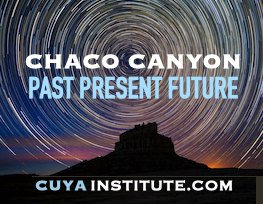
Recently our longtime friend GB Cornucopia, who served for thirty-four years as an interpretive ranger at Chaco Canyon — officially designated as Chaco Culture National Historical Park — shared his concerns about a proposal that could reopen federal lands surrounding the park to expanded oil and gas development. His letter is not simply about policy. It is about stewardship. And we are all stakeholders.
For Paul and I, Chaco is one for the Bucket List. A must-do journey along paths these ancient ritualist-builders once walked, to the rhythmic beat of footsteps on jagged gravel, through key-hole doors that demand you bow, to admire stone-brick walls while still standing, remind you they once reached four-stories high.
Bumping along miles and miles of corrugated dirt road and car camping in the small on-site lots near major petroglyphs made the journey to this remote site all the more evocative. On our first journey there, our friend Gwen Spencer, a good friend of GB, made sure we attended his daily guided walk through one of Chaco’s great houses, where he pointed to the many astronomical alignments most visitors miss.
We can personally affirm that some places do change us. Chaco is such a place. What rituals took place there so long ago, still have the power to threw open a doorway. It felt inevitable, in that it was one we had long been ready to walk through, one that eventually pointed to our life’s work with this Institute. This culminated in Paul’s meditation, sitting alone at the center of Casa Riconanda. This was before the Riconada’s interior was closed, and a larger story for another day. Those encounters that tilt your life’s trajectory, that set a new course, always hold a special place in the heart.
GB too holds a special place in ours. On our second journey to Chaco, he invited us to his ranger quarters and served tea, sharing more of the archaeoastronomy sites, including the famed Sun Dagger. As we were then based in Santa Fe part of the year, Chaco was an easier five-hour drive. So we made returned for more 3-day trips. We were only just scratching the surface.
Friends who’ve spent considerable time there, also close to GB, have conducted a range of research at Chaco. On one Equinox, Tony Hull, astrophysicist, set up a Gnomon, an early, simple and quite accurate device to determine the celestial cardinal points, near structures perfectly aligned North and South. His experiments suggest the Gnomon might well have been known and used by the ancient builders to align several of Chaco’s ancient structures
Tony introduced us to Cherilynn Morrow, cultural astronomer. Cherilynn and GB have also conducted several research projects. In one two-hour interview with us, they spoke in depth of one project, testing the naturally robust acoustics of a ritual site, to suggest the soundscape was an important aspect of ritual, and too often overlooked by archeologists. GB also provided several Chacoan examples of a petroglyph posture we were studying.
GB is now retired. Is there anyone alive who knows this sacred site better? As GB says, Chaco is far more than the buildings preserved within the park boundaries. The surrounding landscape contains thousands of archaeological sites, sacred places, ancient roads, shrines, and cultural connections that continue to hold deep meaning for today’s Pueblo peoples, the Hopi Tribe, the Navajo Nation, and other Indigenous communities.
And for those of us who spend any amount of time there, for the landscape itself is part of the story. Whenever we return to Chaco—whether in person or in memory — we cannot help but wonder if that first visit in some way prepared us for what was to come.
The thought of industrial development pressing against its borders raises important questions about what we —as global stakeholders — choose to preserve for future generations. Every generation inherits places that shaped those who came before us. We also inherit the responsibility to decide what will remain for those who come after.
Whether your connection to Chaco is spiritual, historical, archaeological, or simply human, this remarkable landscape deserves thoughtful consideration. Places like Chaco cannot be recreated once they are diminished.
The deadline for comments is July 29. That is next week, in a mere two week comment period. We encourage anyone who feels a connection to this extraordinary place to learn more about the current proposal and, if moved to do so, participate in the public comment process. Whatever your perspective, Chaco deserves an informed conversation worthy of its remarkable legacy.



 The name “CUYA” carries with it both history and vision. Rooted in our origins as the Cuyamungue Institute, it now also serves as an acronym — C.U.Y.A. — a guiding symbol that unites our mission: