
Anthropological Roots of Ritual Body Postures
The work of CUYA—the Cuyamungue Institute—is deeply rooted in the pioneering anthropological research of Dr. Felicitas D. Goodman. Her most significant contribution to the study of religion and consciousness emerged from a simple yet profound observation: many images found on ancient pottery, sculptures, cave art, and ceremonial artifacts appeared to depict specific body positions rather than random artistic poses.
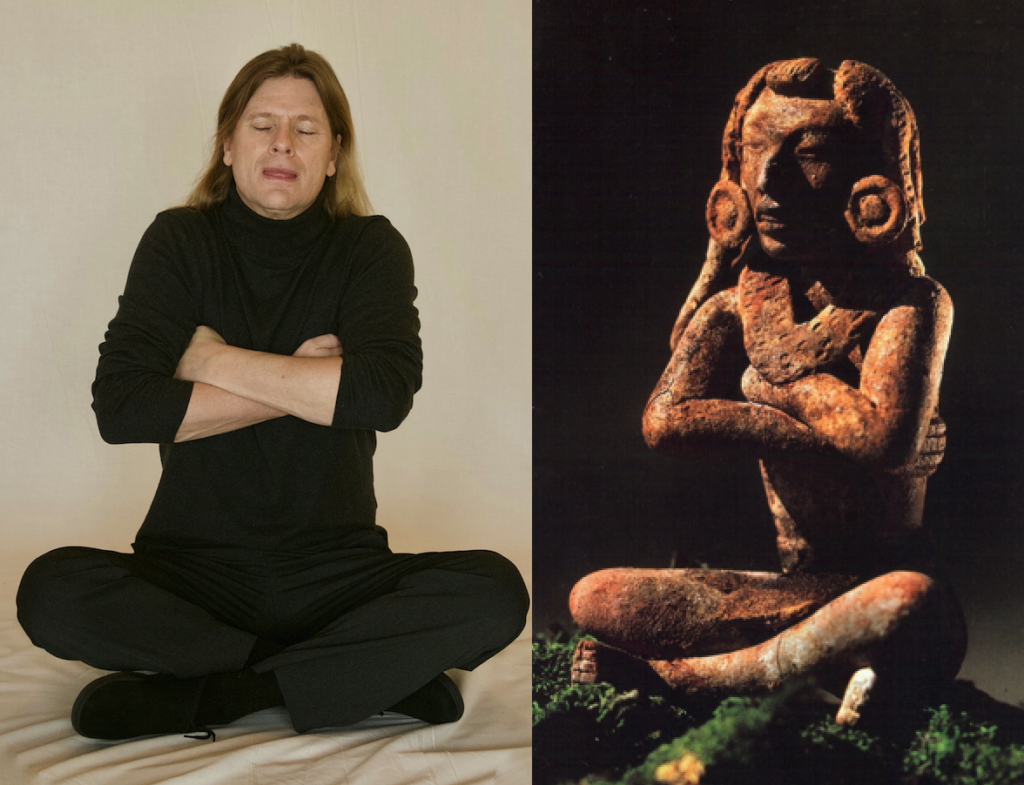
Through years of cross-cultural investigation, Goodman proposed a revolutionary hypothesis: these postures were not merely decorative representations but ritual technologies—physical forms intentionally used to facilitate altered and expanded states of consciousness.
Her insight can be summarized simply:
“If one adopts a particular posture under the appropriate ritual conditions, one may enter a corresponding state of consciousness and encounter a characteristic pattern of experience.”
The evidence for these postures was never hidden. They appear throughout the archaeological record and can be found in museum collections, art history texts, and sacred imagery from cultures spanning thousands of years and multiple continents. What had largely gone unnoticed was their possible function as practical instructions for ritual experience.
To test this hypothesis, Goodman developed a systematic method combining specific body postures, rhythmic sound stimulation, and focused intention. The results were remarkable. Ordinary individuals with no prior training were able to enter altered states of consciousness and consistently report experiences that showed striking similarities across participants.
This breakthrough opened new avenues for anthropological inquiry. For the first time, researchers could investigate ritual consciousness not only through historical interpretation but through direct experiential and phenomenological study. Because participants remained physically stationary while assuming the postures, the method also provided opportunities for physiological and neuropsychological research that would be difficult to conduct during movement-based ritual practices.
Today, Ritual Body Postures continue to bridge anthropology, consciousness studies, spirituality, and human experience. They offer a rare opportunity to explore ancient forms of knowledge through direct participation, allowing modern practitioners to engage with practices that may have been part of humanity’s spiritual heritage for tens of thousands of years.
At CUYA, we continue Dr. Goodman’s legacy by preserving, researching, teaching, and experiencing these remarkable postures as living pathways into expanded awareness and human potential.
By developing a prescribed method by which ordinary individuals are able to enter the religious altered state of consciousness, she made technical inquiry into this state both from a phenomenological as well as a physiological perspective. One advantage with this method is that the subject is stationary, allowing neurophysiological research to be conducted. In addition, subjects are able to describe their experiences in terms that are understandable to the investigator.
During her career as an anthropologist, Dr. Goodman published 12 books and numerous articles published in professional journals, including:
- Speaking in Tongues: A Cross-Cultural Study of Glossolalia, The University of Chicago Press, Chicago, 1972.
- Disturbances in the Apostolic Church: A Trance-Based Upheaval in Yucatán, In Trance, Healing, and Hallucination: Three Field Studies in Religious Experience, by Felicitas D. Goodman, Jeannette H. Henney, and Esther Pressel, Wiley Interscience, New York, 1974.
- The Exorcism of Anneliese Michel, Doubleday, New York, 1981 (translated into German and French)
- How About Demons? Possession and Exorcism in the Modern World, Indiana University Press, Bloomington and Indianapolis, 1988. (translated into German)
- Ecstasy, Ritual, and Alternate Reality: Religion in a Pluralistic World, 1988 (translated into German)
- Where the Spirits Ride the Wind: Spirit Journeys and Other Ecstatic Experiences, Indiana University Press, Bloomington, 1990. (translated into German)
- Trance Der uralte Weg zum religioesen Erleben, Gütersloher Verlagshaus, Gerd Mohn, 1992. (translated into Dutch, Hungarian, and Spanish)
- My Last Forty Days: A Visionary Journey among the Pueblo Spirits, 1997.
- Maya Apocolypse: Seventeen Years with the Women of a Yucatan Village Indiana University Press, Bloomington and Indianapolis, 2001.
- Possible Physiological Mechanisms for Some Cases of Faith Healing, Medikon 3(6/7):39-41, 1974.
- States of Consciousness: A Study of Soundtracks. Journal of Mind and Behavior 2:209-219, 1981.
- Body Posture and the Religious Altered State of Consciousness: An Experimental Investigation, Journal of Humanistic Psychology, 26:81-118, 1986.
- Speaking in Tongues: A Cross-Cultural Study of Glossolalia, The University of Chicago Press, Chicago, 1972.
- A Trance Dance with Masks, The Drama Review, 34(1):102-113, 1990.
- Ritual Body Postures and Ecstatic Trance: Implicit Myths and Healing, Yearbook of Cross-Cultural Medicine and Psychotherapy, 1998/99: 43-50.
- Ritual Body Postures, Channeling, and the Ecstatic Trance, Anthropology of Consciousness 10 (1): 54-59.