Yesterday I woke from what felt like a deeply significant dream. It contained a vivid conversation that has stayed with me throughout the day, leaving me with the quiet sense that it may hold guidance for the path ahead. Whether that proves to be true or not, it reminded me how dreams have an uncanny way of speaking to us long after we awaken.
Perhaps you’ve had a similar experience. A dream that lingered long after morning. One that carried an emotional weight words could never quite capture. Maybe it introduced a mysterious presence or a conversation that felt more real than ordinary waking life. It is easy to dismiss these experiences as “just dreams,” yet something inside me quietly wonders if they are more. There is sometimes a subtle sense of knowing that refuses to disappear.
Dreams have always occupied a mysterious place in human life. Across cultures and throughout history they have been regarded as sacred companions on life’s journey – a doorway into deeper dimensions of consciousness where wisdom, healing, and transformation can emerge.
Dreams rarely speak in literal language. Instead, they communicate through symbols, emotions, and living images. This symbolic language has fascinated psychologists, mystics, shamans, and spiritual seekers because it often reveals aspects of ourselves that remain hidden during ordinary waking awareness. I have come to think of dreams as a way of gently bypassing the analytical mind and inviting us into a deeper conversation with ourselves.
Many of our most meaningful dreams also seem to follow an ancient pattern—the journey of awakening. We leave what is familiar, encounter uncertainty, receive unexpected guidance, and awaken somehow changed. Whether we recognize it or not, our dreams often participate in an ongoing pilgrimage toward wholeness.
Dreams can also be deeply challenging. They may dismantle old identities, expose fears we have long avoided, or confront us with aspects of ourselves we would rather not see. Yet, in time, these experiences often become deeply transformational. The dream world has a remarkable way of revealing what no longer serves us so that something more authentic can emerge.
Throughout the world’s Indigenous traditions, dreams have long been understood as an important extension of reality. Australian Aboriginal teachings describe the Dreaming as an ever-present dimension woven into creation itself – a sacred reality that continues to shape the relationship between people, the land, and the ancestors. Many Indigenous cultures understand sleep as a time when the spirit is free to travel, to receive guidance from ancestors, to learn from the natural world, and to encounter realms that exist beyond ordinary perception.
While each tradition expresses these understandings differently, they share a profound respect for dreams as a bridge between the visible and invisible worlds. Whether we interpret dreams spiritually, psychologically, or neurologically, they continue to remind us that the human experience is richer and more mysterious than our waking minds alone can explain.
Modern neuroscience offers its own fascinating perspective. During dreaming, the brain naturally enters patterns of activity associated with altered states of consciousness. The ordinary structures of time, identity, and logical thinking soften. The boundaries of the ego become more fluid. In many ways, dreaming is one of the most natural altered states of consciousness that every human being experiences throughout life.
At CUYA, this understanding has taken on special significance through our work with Ritual Body Postures. For decades, inspired by the pioneering research of Dr. Felicitas Goodman, we have explored how specific postures, combined with rhythmic sound, can intentionally open the doorway into expanded states of consciousness while remaining fully awake.
This continues to be one of the most fascinating aspects of our work. We have found that the landscapes encountered through Ritual Body Postures often resemble the symbolic terrain of profound dreams. Practitioners describe journeys into mythic worlds, encounters with compassionate beings, transformations into animals, meetings with ancestors, and experiences where ordinary time simply disappears. These experiences feel far more vivid than ordinary imagination. They possess an immediacy that, to me, closely parallels the deepest and most meaningful dreams.
It is as though the body itself becomes a key. Through the simple act of assuming a particular posture and allowing rhythmic sound to quiet the ordinary mind, the body seems to unlock a doorway that dreams naturally open during sleep. Rather than waiting for these encounters to arise spontaneously in the night, Ritual Body Postures allow us to enter that same symbolic landscape consciously, awake, and fully present. For me, this has become one of the most fascinating relationships between dreaming and embodied spiritual practice.
This is one of the reasons I have come to appreciate dreams so deeply. They remind us that expanded consciousness is not something reserved for a select few. It is woven into our humanity. Every night we cross a threshold into a world where symbols replace certainty, mystery replaces explanation, and the deeper intelligence of life continues its quiet work within us.
Perhaps dreams are invitations. Invitations to remember that consciousness is larger than our waking thoughts. Invitations to trust that wisdom often arrives through image rather than argument. Invitations to rediscover that the sacred has never been far away—it has simply been waiting for us to notice.
Whether through sleep, meditation, embodied practices such as Ritual Body Postures, or moments of profound stillness in nature, these experiences remind us that there is a living conversation continually unfolding between ourselves and the greater mystery of existence.
As I write these final words, I still don’t know exactly what my dream was trying to tell me. Perhaps I never will. But I have learned that not every dream asks to be explained. Some simply ask to be honored…and remembered.
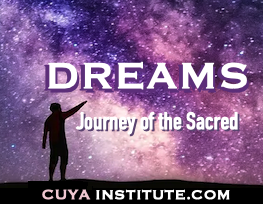
Maybe that is where the journey of the sacred begins.



 The name “CUYA” carries with it both history and vision. Rooted in our origins as the Cuyamungue Institute, it now also serves as an acronym — C.U.Y.A. — a guiding symbol that unites our mission: