There are things we seem to know without quite knowing how we know them. A rhythm begins and the body wants to move. We gather in a circle, bow our heads in silence, reach out to touch another person, or stand beneath a night sky and instinctively look upward. The body often seems to understand something about these moments before the mind has had time to explain them.
I have become increasingly interested in this kind of knowing. Through the years Laura and I have spent exploring consciousness, ritual, ancient cultures, and embodied spiritual practices, I have found myself returning again and again to a simple question: How much of human experience has been carried forward not through written history, but through the things human beings continue to do?
In our modern world, we tend to think of remembering as the ability to retrieve information about the past. For most of human history, however, knowledge had to be carried very differently. It lived in stories told around fires, songs repeated generation after generation, dances, ceremonies, gestures, sacred objects, and places people returned to again and again. It was carried in the way people gathered, mourned, celebrated, and marked the great transitions of life.
Much of that knowledge was also carried in the body. Long before most human experience could be written down, repetition mattered. A story had to be told again. A song had to be sung again. A dance had to be danced again. A ceremony had to be performed again. Knowledge survived because people participated in it, and participation gave memory a physical form.
This is one of the things I find so compelling about ritual. A story can tell us what happened, but ritual asks us to enter the story ourselves. We light the fire, hear the rhythm, enter the circle, speak the words, make the gesture, or still our body and assume a posture. We are no longer simply observers of something that happened to someone else. For a time, we become participants in a pattern of human experience that may have been repeated countless times before us.
Human beings carry experience forward through participation. We watch one another. We imitate. We engage. We teach our children, and they eventually teach theirs. A gesture, song, story, or ceremony can continue moving through generations even as the world surrounding it changes.
In this sense, the body becomes one of culture’s oldest forms of transmission. We can see this in traditions throughout the world where story, movement, landscape, song, ceremony, and community remain intertwined. Australian Aboriginal songlines are one well-known example, connecting ancestral narratives and song with journeys through the land and knowledge of particular places. The knowledge remains alive because it continues to be practiced, sung, traveled, and shared.
This way of looking at memory has also changed how Laura and I encounter ancient artifacts. Over the years, whether traveling to archaeological sites, walking through museums, or researching the ancient figures that have become part of our work with Ritual Postures, we have learned to look beyond what an artifact represents and pay close attention to what the human figure is actually doing. We notice the placement of the hands, the position of the feet, the angle of the head, whether the figure is standing, sitting, kneeling, or crouching, and how the body is being held.
The body depicted in clay, stone, wood, or metal becomes evidence of another human body that once moved, stood, knelt, danced, prayed, or participated in ritual. Seen in this way, an ancient artifact can carry profound information about how human beings once used their bodies to engage with one another and with the world around them.
A gesture can travel an astonishing distance through time. Hands are placed over the heart or abdomen. Arms reach toward the sky. Palms turn upward. Heads bow or tilt back. Bodies gather in circles. Feet are planted upon the earth. Rhythmic movements are repeated. We encounter variations of these patterns in cultures separated by enormous distances and long periods of time. What also interests me is their persistence and what that persistence may tell us about the continuity of human experience.
The world surrounding us has changed almost beyond recognition, but the fundamental human experiences within that world remain remarkably familiar. Our ancestors lived without modern technology or the constant stream of information that now surrounds us. Their lives were shaped much more directly by weather, animals, seasons, birth, death, dreams, hunger, darkness, and the immense mystery of the night sky. Yet like us, they breathed, danced, embraced one another, grieved their losses, celebrated their joys, entered into silence, and experienced wonder and fear.
This is why I think ritual has survived nearly every transformation of human culture. The circumstances change, but the great passages of human life remain. We are born. We grow. We form relationships. We experience love and separation. We face illness and uncertainty. We celebrate. We grieve. We grow older. We die. Every generation encounters these experiences for the first time, even though humanity has been encountering them from the beginning.
Ritual gives these experiences a container. It provides a way of entering moments that can otherwise overwhelm us and reminds us that others have stood where we are standing now. Ritual places our individual experience within a much larger human story.
I think this is also why ritual continues even when traditional religious or cultural frameworks begin to change or fade. We graduate in robes and cross a stage. We gather for weddings and funerals. We stand together at memorials. Crowds sing together at sporting events. Families repeat traditions whose origins may have long since been forgotten. Even the small routines of daily life can take on a ritual quality when they create order, familiarity, and meaning in the midst of uncertainty. The forms continue to change, but the human impulse to mark important moments remains.
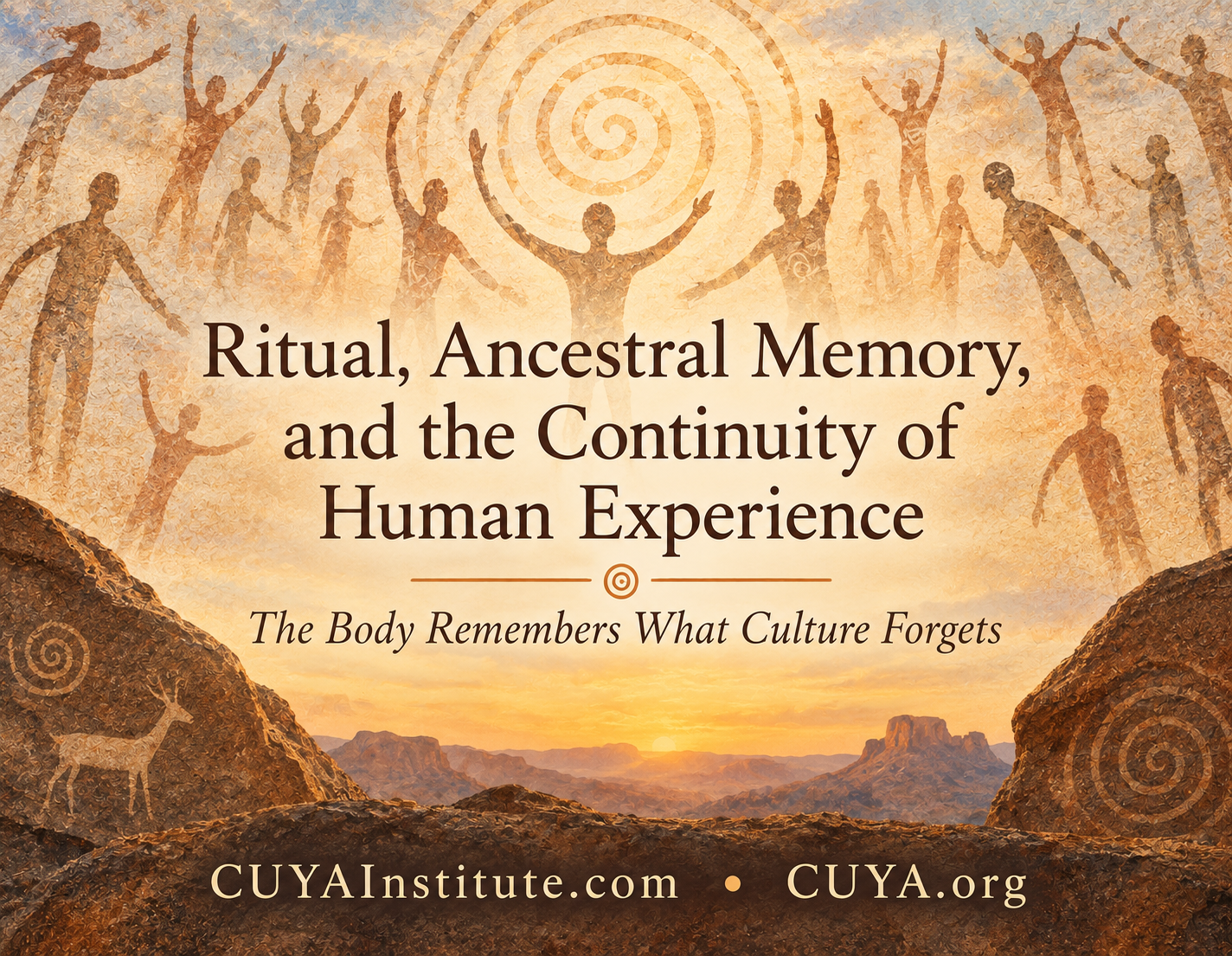
This is what I mean when I say the body remembers what culture forgets. I am not talking about memory in the ordinary sense, but about continuity carried through human beings themselves. Memory is not always something we do alone. We also remember together, through repetition, relationship, story, movement, ritual, and shared experience.
There are moments in ritual when our usual sense of chronological time becomes less important. A story may come from hundreds or thousands of years ago, yet when it is sung, danced, spoken, or embodied again, it enters the present. This is not about literally returning to the world of our ancestors. It is about recognizing that we are participating in something human beings before us also understood: the need to step outside ordinary activity, gather together, create meaning, and acknowledge experiences larger than the individual self.
For me, this is one of the quiet gifts ritual continues to offer. It reminds us that our lives did not begin with us. We inherited a world already filled with gestures, stories, songs, symbols, ceremonies, questions, fears, hopes, and ways of reaching toward the unknown. We receive them, consciously or unconsciously, add our own experiences to them, and pass some of them onward.
Our technological world is moving forward at an astonishing pace. I find myself increasingly aware that moving forward does not require us to leave every older form of human knowing behind. Information gives us extraordinary access to what other people have discovered, but information and experience are not the same thing. There are things we understand by thinking and things we understand by being told. There are also things we come to understand only through participation.
A rhythm begins, a circle forms, the body becomes still, and the hands find their place. In such moments, the distance between ourselves and those who came before us can feel surprisingly small. The body may not be remembering a particular ancient story at all. It may be remembering something much more fundamental: how to participate in the human story.



 As a 501(c)(3) nonprofit educational organization, we depend on your support to continue our work. We invite you to join our community and be part of this ongoing journey of exploration and discovery. more….
 The name “CUYA” carries with it both history and vision. Rooted in our origins as the Cuyamungue Institute, it now also serves as an acronym — C.U.Y.A. — a guiding symbol that unites our mission: