More than twenty-five years ago, I had an idea that stayed with me. I wanted to create a space devoted to exploring what it means to be an elder. I had been inspired by cultures around the world in which elders continued to hold a meaningful place within their communities, not simply because of their age, but because their years of living had given them something of value to offer.
I purchased the domain GlobalElders.com. My vision was to honor people whose wisdom had been shaped over decades and create a place where they could share their stories, insights, mistakes, discoveries, and guidance with others. One project led to another, and I never fully developed the website. But for some reason, I never let the domain go. Now I think I understand why the idea stayed with me.
I have reached an age when the difference between growing old and becoming an elder is no longer an abstract idea. It has become personal. And I find myself thinking again about something that first caught my attention all those years ago: What happens when a culture has no meaningful role for its elders?
Growing older happens automatically. Becoming an elder does not.
Age gives us experience, but experience alone does not necessarily give us wisdom. We have all known people who have lived many years without becoming particularly reflective about those years. Eldership asks something more of us. It asks that we take what life has given us, the successes and failures, love and loss, certainty and doubt, and do something with it. It asks us to turn experience into understanding. Becoming an elder requires reflection, emotional maturity, and a willingness to continue growing.
This is one reason I have become increasingly interested in the traditional role of elders. In many cultures, elders have served as keepers of memory, tradition, story, practical knowledge, and spiritual understanding. They provide continuity between generations. They remember what happened before the present generation arrived, what was tried, what worked, what failed, what was lost, and what should not be forgotten.
I also think we sometimes make the mistake of imagining “the elder” as a single wise person sitting at the center of the village with all the answers. What interests me more is the idea of a community of elders. One person may understand matters of the heart. Another may carry spiritual wisdom. Someone else may know the land, medicine, plants, craftsmanship, family histories, ceremony, or how to help people through grief. Another may simply have the extraordinary ability to listen without immediately telling someone what to do. Their wisdom is different because their lives have been different.
Together, these people create something larger than any one individual. No one person has to possess all wisdom. A healthy community recognizes different kinds of experience and knows where to turn when that experience is needed. I think there is something deeply human about this, and I wonder how much of it we have lost in modern Western culture.
We have become extraordinarily good at valuing what is new: new technology, new ideas, new products, new voices, new ways of doing things. Curiosity and innovation are essential parts of being human. But when newness itself becomes a measure of value, something important begins to disappear. A culture that values youth but has little understanding of eldership eventually teaches people to fear aging.
We see this everywhere. We speak of remaining young rather than growing old well. We celebrate looking younger than our age. Entire industries are built around hiding the visible evidence that we have lived. Even the language of aging is frequently about decline, loss, and irrelevance. But what if the later years of life were understood differently? What if they carried not only the possibility of wisdom, but a responsibility to cultivate and share it?
The question would no longer be simply, How do I stay young? It might become, What have I learned that is worth passing on? That is a very different way of approaching age.
I also don’t believe eldership should be something we simply claim for ourselves. In traditional communities, the role of elder was often connected to relationship and recognition. People became elders partly because others came to trust their judgment, their steadiness, their knowledge, or their ability to see beyond the immediate problem. That kind of trust takes time, and it has to be earned. Eldership also asks us to cultivate curiosity, to listen deeply, and to find ways of transforming the wounds and lessons of our own lives into understanding that may be of value to others.
True eldership requires humility because life has usually taught us how often we have been wrong. It requires listening because we eventually discover that advice is not always what another person needs. It requires compassion because by this point in life most of us have experienced enough joy, disappointment, love, grief, success, and failure to recognize something of ourselves in the struggles of others. And it requires continuing to grow. The elder who believes there is nothing left to learn has stopped doing one of the very things that makes wisdom possible.
For Laura and me, much of our adult lives has been devoted to exploring consciousness, ritual, ancient cultures, and the ways human beings have sought meaning across generations. Our work at the CUYA Institute has brought us into contact with practices and traditions that continually remind us that we are part of something much older than ourselves. Ritual Body Postures are one part of that exploration, but the larger lesson has been about learning to listen, to experience, and to recognize that knowledge is not limited to what we can accumulate intellectually.
The body has wisdom. Experience has wisdom. Community has wisdom. Our ancestors have left wisdom behind for us. And our own lives, if we pay attention to them, are continually trying to teach us something. I think this is one of the responsibilities of becoming an elder: to pay attention, to look back over a lifetime without becoming trapped in the past, to recognize patterns, to acknowledge mistakes without being defined by them, and to remember what mattered and what turned out not to matter nearly as much as we once thought. Then, when appropriate, we can offer some of that understanding to those coming behind us, not as someone who has all the answers, but as someone who has traveled farther down the road.
There is another side to this. A society cannot reclaim eldership simply by asking older people to become wiser. Younger generations have a role as well. Wisdom that is never sought has nowhere to go, and there has to be a relationship between generations. The elder needs the curiosity, energy, new ideas, and changing perspective of younger people just as younger people can benefit from the long view of those who have already lived through several cycles of change. Neither replaces the other. Something important happens when they remain in conversation.
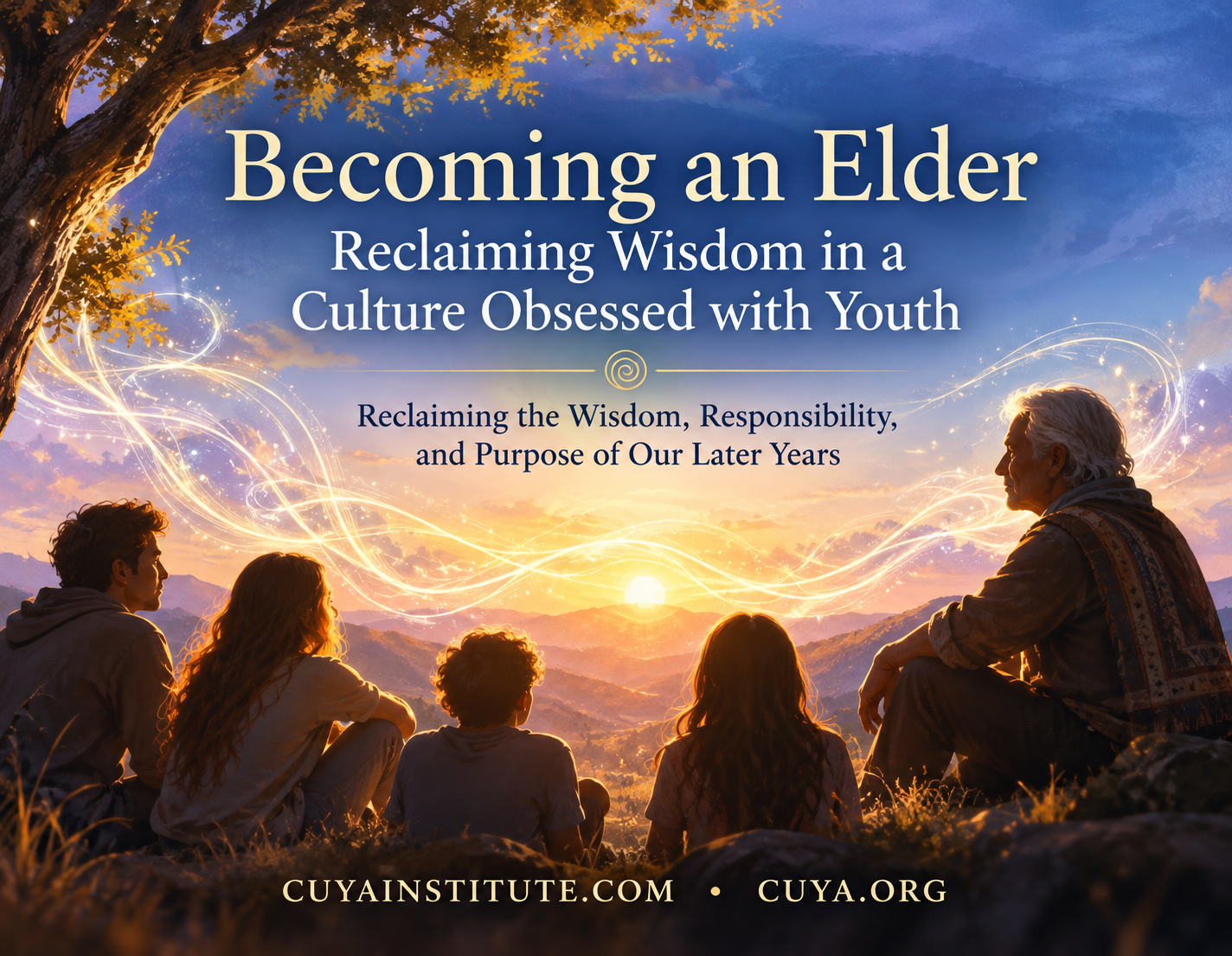
This is why I think reclaiming eldership is about much more than aging. It is about restoring continuity. Every generation inherits a world it did not create and eventually hands that world to people who will continue after it is gone. Eldership occupies an important place in that exchange, standing between memory and possibility, carrying what has been learned while making room for what has not yet been imagined.
So years ago, when I registered GlobalElders.com, I thought I was creating something for other people. I imagined finding elders around the world and giving them a place to share what they knew. I see it differently now. At some point, without quite noticing when it happened, I crossed the threshold into the very stage of life I had been thinking about all those years ago. And, in all honesty, that domain is still sitting there, waiting for the right time to be fully developed and launched.
The question is no longer simply how we should treat our elders. The question has become much more personal: What kind of elder do I want to become? We all grow older through the passage of time, but not everyone becomes an elder. Eldership asks something more of us. And I think that is a question worth asking long before we consider ourselves old.



 As a 501(c)(3) nonprofit educational organization, we depend on your support to continue our work. We invite you to join our community and be part of this ongoing journey of exploration and discovery. more….
 The name “CUYA” carries with it both history and vision. Rooted in our origins as the Cuyamungue Institute, it now also serves as an acronym — C.U.Y.A. — a guiding symbol that unites our mission: