We tend to think of perception as something that happens primarily through the five senses and is then interpreted by the brain. But what if the body itself is an instrument of perception?
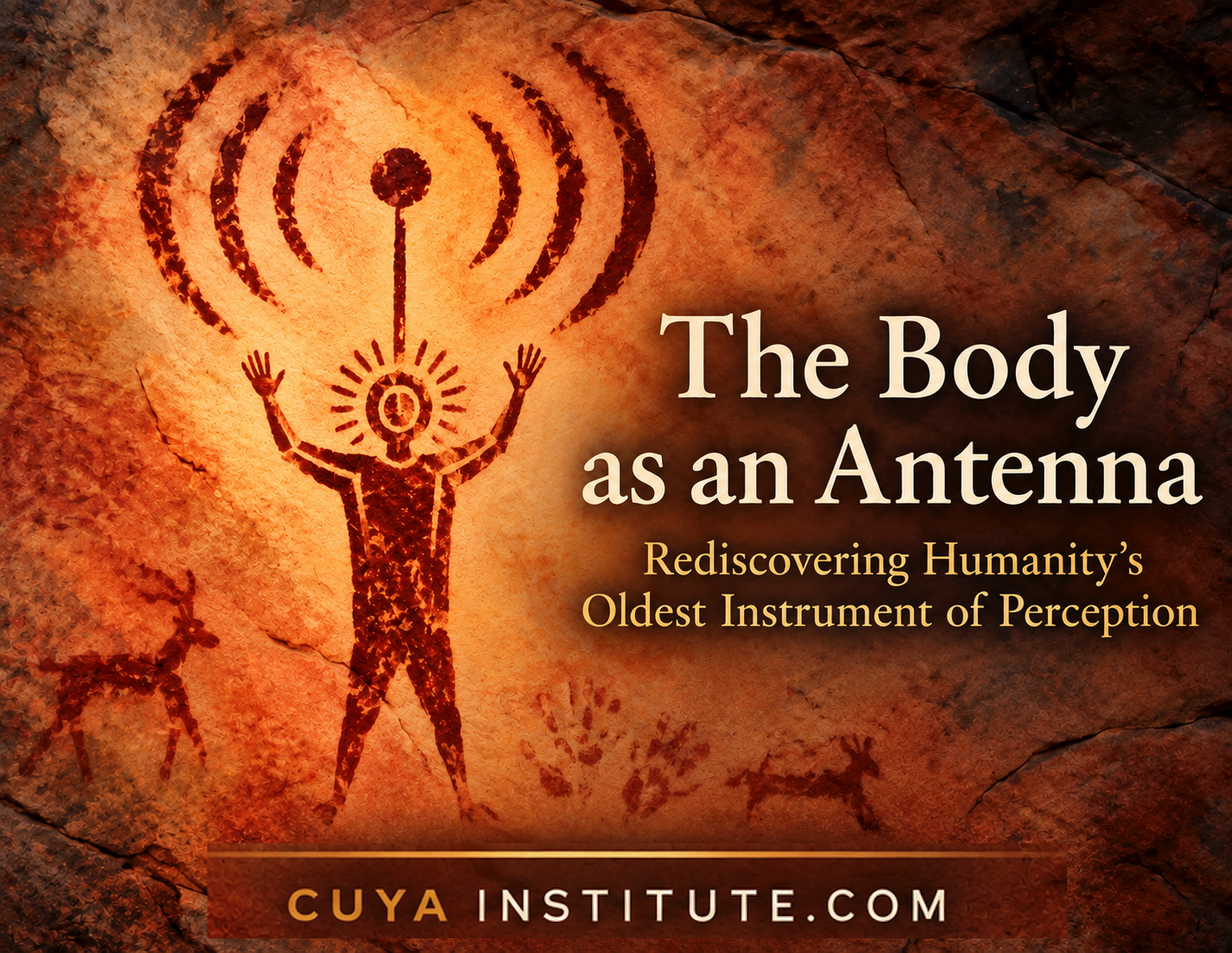
I like to think of it as an antenna. An antenna does not create the signals it receives. It becomes receptive to something already present and translates that signal into information. This describes something I have observed again and again: when we change what we are doing with the body, we can change what becomes available to our awareness. This simple idea is central to how I understand much of the work we do at the CUYA Institute.
Modern life places enormous value on the thinking mind, which to me seems like an imbalance. We analyze, categorize, compare, explain, and interpret. These abilities have given us extraordinary tools for understanding the world, but thinking is not the only way we know something. We all have experiences of knowing through the body. Instead of treating the body as something that carries the brain from one place to another, I am more interested in what happens when we regard the whole body as participating in awareness. The body is not simply responding to experience. It is part of how we receive and experience the world.
This understanding is at the heart of the work of anthropologist Dr. Felicitas Goodman, whose research became the foundation of the CUYA Institute. Goodman became fascinated by something that can easily be overlooked in ancient art: the position of the human body. Across different cultures and periods of history, people created figures standing, sitting, kneeling, crouching, or holding their arms and hands in very specific ways. Rather than looking only at what these figures represented, Goodman asked a wonderfully simple question: What happens if we put our own bodies into these positions?
Through years of research and experimentation, she found that certain postures, when combined with rhythmic sound, could facilitate distinctive experiences of expanded consciousness. Even more intriguing, people using the same posture often reported experiences with recognizable similarities, even when they had not been told what they were expected to experience. This remains one of the most fascinating aspects of Ritual Postures for me. The position of the body matters. Change the posture, and the experience can change. That observation brings us directly back to the idea of the antenna.
When we assume a Ritual Posture, we are not simply arranging our arms and legs to imitate an ancient artifact. Breathing changes. Muscle tension changes. Balance changes. Attention changes. Our relationship to space changes. The entire physical configuration through which we experience the moment has been altered. Then we add rhythmic sound, and for a short period of time our usual way of organizing experience begins to shift. The constant commentary of the thinking mind becomes less dominant, and another kind of awareness can emerge.
People describe what follows in many different ways. Some experience vivid imagery. Others encounter animals, landscapes, ancestors, or symbolic figures. Some experience movement, energy, emotion, or a powerful sense of connection. Others receive something surprisingly simple: a feeling, an understanding, or an insight that seems to arrive without explanation. I am less interested in immediately deciding where these experiences come from and more interested in what happens when we allow ourselves to experience them fully. We are very quick to name things. An unusual experience occurs and almost immediately the mind wants to determine what it was, where it came from, and what it means. We want to place it into a familiar category. But the body often seems to know something before we have an explanation for it.
Through the years Laura and I have spent exploring consciousness, ritual, meditation, ancient cultures, and our work with Ritual Postures, we have come to recognize that this kind of embodied knowing extends far beyond Ritual Postures. It happens in meditation, prayer, dance, music, creativity, time spent in nature, and moments of deep human connection. It can happen while standing before an ancient place or simply sitting quietly beneath the night sky. Something changes in us. We become more present, and as we become more present, we become more receptive.
What makes Ritual Postures particularly interesting is the power of stillness. We do not need to move the body once the posture has been assumed. The body is placed in a specific position and held there. I sometimes think of the old rabbit-ear antennas we used to have on television sets. To receive a particular channel more clearly, we moved the antenna into just the right position and then left it there. The antenna didn’t need to keep moving. Its position determined what it was able to receive. In much the same way, each Ritual Posture places the body into a particular configuration and then allows us to become still and experience what follows.
Across cultures and throughout history, people have danced, knelt, bowed, raised their hands, breathed in particular rhythms, sat in silence, walked in procession, drummed, chanted, swayed, fasted, and become still. The practices are different, the beliefs surrounding them are different, and the cultures that created them are different, but the body is almost always involved. I don’t think that is accidental. For most of human history, there was no sharp division between the life of the body, the life of the community, the natural world, and the search for meaning. The body was not separate from these experiences. It was the means through which they were lived.
The antenna metaphor also helps me understand something about modern life. Reception depends partly upon interference, and our lives are filled with it. We move rapidly from one thought to another, one screen to another, one obligation to another. We spend enormous amounts of time interpreting experience and surprisingly little time simply experiencing it. Yet the body keeps bringing us back. Breath brings us back. Sensation brings us back. Movement brings us back. Posture brings us back.
This is something many contemplative and ritual practices share. Their methods may be very different, but they interrupt our habitual patterns long enough for us to notice something else. Sometimes what we discover is simply a deeper awareness of ourselves. Sometimes it is a connection with another person, the natural world, or the community around us. And sometimes the experience seems to reach beyond the boundaries of the familiar self altogether.
One of the things I value most about this work is its simplicity. We do not need to acquire another piece of technology, and we do not need to begin with a particular belief about consciousness. We begin with the instrument we already possess. We become quiet enough to notice the body. We change our breathing, our posture, or the way we direct our attention. We listen to rhythm. We become present to what is happening, and we discover what becomes available when the usual noise settles and another kind of awareness has room to emerge.
This is why I have come to think of the body as one of humanity’s oldest instruments for exploring consciousness. Long before laboratories, brain scans, or theories of consciousness, human beings had the same instrument available to them that we have today: the human body. Our ancestors learned to work with it through movement, rhythm, ritual, stillness, breath, and posture. They discovered ways of changing consciousness by changing what they did with the body.
We still carry that instrument with us, and the work we do at the CUYA Institute continues that exploration. Ritual Postures give us one particularly fascinating way of discovering what the body can reveal when we stop treating it simply as something we inhabit and begin listening to it as part of consciousness itself. The instrument has been with us all along. We are simply learning how to use it again.



 As a 501(c)(3) nonprofit educational organization, we depend on your support to continue our work. We invite you to join our community and be part of this ongoing journey of exploration and discovery. more….
 The name “CUYA” carries with it both history and vision. Rooted in our origins as the Cuyamungue Institute, it now also serves as an acronym — C.U.Y.A. — a guiding symbol that unites our mission: