We tend to think of language as something that begins with words. Entire civilizations have been built upon our remarkable ability to communicate through language. Yet I also like to explore the idea of what communication looked like before there were words. Indications are that the first language was not spoken at all.
Even today, much of what passes between us happens in silence. We recognize affection, uncertainty, grief, and joy through subtle changes in the body long before anyone begins to speak.
I can’t help but wonder what it felt like to be one of our prehistoric ancestors—not simply how they looked or survived, but how they experienced one another. Imagine a small group moving across an unfamiliar landscape. There is no written language, and maybe spoken language is still in its earliest forms. One person notices something in the distance. They stop. The others notice. A hand rises. Everyone becomes still. Heads turn together toward the same point on the horizon. Whatever happens next may not require a single word. Movement itself carries the message.
This possibility brings me back to the human body as the oldest instrument of communication. Before we learned to describe our experiences, we could enact them. Before we could explain where we were going, we could point. Before we could tell stories, we could embody them. The body became a living vocabulary, capable of expressing intention, warning, invitation, grief, celebration, and belonging without the need for speech.
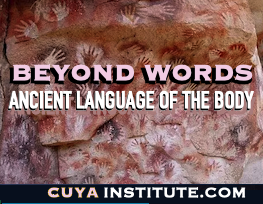
The archaeological record offers us clues to the story rather than complete stories. We discover bones, tools, pigments, carvings, figurines, footprints, burials, cave paintings, petroglyphs, and other images etched or painted onto stone. These remarkable traces suggest that our ancestors were not simply recording what they saw, but were finding ways to communicate what they experienced, remembered, feared, or imagined. Yet they rarely tell us precisely what any particular symbol meant. I find this inviting. It leaves room for curiosity rather than certainty, and questions often lead us further than answers.
I do not want to romanticize prehistoric life. Our ancestors endured hardships that most of us can scarcely imagine, and survival demanded constant vigilance. But they may have inhabited the world differently. They lived closer to weather, animals, darkness, fire, birth, death, and the changing seasons. Their attention was not optional; it was essential.
Maybe communication began not with the desire to speak, but with the necessity of paying attention. The body was continually reading the world, gathering information long before it had words to describe it.
That thought brings me back to the present. We possess more words, more information, and more sophisticated technologies than any generation before us. Yet I am not convinced we always pay better attention. That is one of the questions that interests me most—not whether ancient humans had a language before words, but whether some of those older forms of communication still have something to teach us. The path of listening has never been more important than in today’s world.
When I look at ancient images and sculptures of the human form, I wonder if we are seeing more than representations of people. Could some of these figures preserve memories of how people once stood, gathered, celebrated, mourned, or entered particular states of awareness? It was a question Dr. Felicitas Goodman asked, and it became the foundation of the work of this Institute. An artifact is silent, but maybe the posture of the artifact is not. Rather than asking only, What does this object mean?, Dr. Goodman asked a different question: What happens if the body assumes this position? Could the posture contain encoded instructions?
Maybe words are simply one chapter in a much older human story of learning to communicate—with one another, with the natural world, and with those mysterious parts of ourselves for which we still have no adequate language. Perhaps the oldest languages are not lost, only waiting to be heard again.



 The name “CUYA” carries with it both history and vision. Rooted in our origins as the Cuyamungue Institute, it now also serves as an acronym — C.U.Y.A. — a guiding symbol that unites our mission: