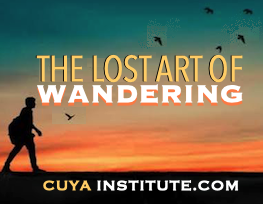
More and more, it seems we have become a society of destinations, especially in Western culture. We are encouraged to know where we are going, why we are going there, how long it will take to get there, and what we hope to accomplish when we arrive. Even our leisure has become an organizational project. We plan our vacations, map our routes, schedule our experiences, count our steps, measure our sleep, and sometimes return home needing to recover from the effort of relaxing.
There is nothing wrong with having a destination. A sense of purpose can give direction to our lives, and plans can help us accomplish things that might otherwise remain only dreams. But somewhere along the way, we may have lost something equally valuable. We have forgotten how to wander.
To wander is to move without being entirely certain where we are going. It is to take the road that looks interesting rather than the one that promises the shortest arrival time. It is to enter a bookstore without knowing what book we are looking for, begin a conversation without already knowing what we want to say, or follow an unexpected idea simply because it has captured our curiosity.
Wandering leaves room for discovery. When every moment has a purpose, there is little space for the unexpected. Yet some of life’s most meaningful experiences arrive when we are not looking for them. A chance encounter can become a friendship, a wrong turn can lead us to a place we might never have seen, and a passing thought can become an idea that changes the direction of our lives.
Not everything valuable can be found by following a map.
There is also an art to mental wandering. We are often taught to think of a wandering mind as an undisciplined mind. We are told to focus, concentrate, stay on task, and avoid distraction. There are certainly times when focused attention is necessary, but there are other times when the mind needs the freedom to simply “space out” and move without a predetermined destination.
Modern-day psychology tells us that when we daydream, reflect, imagine, or simply allow our thoughts to drift, our minds do not necessarily become inactive. They continue processing, making connections, and bringing together thoughts that may have seemed unrelated. Memories can rise unexpectedly, questions can emerge, and ideas can find one another in ways that might never have occurred while we were concentrating on finding a particular answer.
Some of our most creative insights may begin this way. They arrive because we finally gave them room. True curiosity also requires this kind of freedom. When we are not immediately concerned with producing a result, we can follow an interest simply because it draws us forward. We can explore without having to justify where the exploration will lead.
It also seems that relaxation has become something of a lost art. In our culture, doing nothing is often confused with accomplishing nothing. Rest can be seen as idleness, and taking time without a measurable purpose can feel almost irresponsible. The pressure to be constantly productive has become so deeply woven into our lives that we can feel guilty when we are simply sitting quietly.
But relaxation is not a failure to be productive. It is a necessary part of being human. The body needs rest, the mind needs quiet, and our emotional lives need moments when we are not constantly responding, deciding, producing, and moving on to the next thing. Without those spaces, we can gradually lose contact with ourselves.
Wandering offers another kind of freedom. It frees us, at least temporarily, from the constant pressure to know. We do not have to know where the path will lead. We do not have to understand what an experience means while it is happening. We do not have to immediately turn every thought into a conclusion or every experience into a lesson. Sometimes it is enough to remain curious.
This can be especially difficult in a world that rewards certainty. We are often expected to have opinions, answers, plans, and explanations. Yet wandering asks something different of us. It asks us to remain open. It invites us to follow a question without demanding that we immediately find an answer. There is a certain freedom in being able to say, I wonder what might happen if I keep going.
Laura and I have often discovered that some of the most meaningful experiences in our lives have emerged in precisely this way. They were not always planned, and they did not begin with a clearly defined destination. Sometimes they began with curiosity, an unexpected encounter, an artifact, a question, or simply a willingness to explore something we did not yet understand. Over time, those moments often led us in directions we could never have predicted.
This spirit of wandering is also deeply connected to the work of the Cuyamungue Institute. Our work with Ritual Postures begins with ancient images and artifacts, created by people whose lives are separated from ours by centuries, and sometimes millennia. We can study them, examine their cultural context, and learn what archaeology and anthropology may tell us about them. But there comes a point when information alone is not enough.
The posture invites us to step beyond what we know. It is a process of letting go as we enter an experience without being certain where it will take us. Each session begins without a predetermined outcome. We do not know what images, emotions, memories, insights, or experiences may emerge. There may be some sense of direction, but there is no map.
This is where Laura and I have come to embrace the unknown as part of our life journey. It is one of the qualities that has continued to draw us to this work. We begin with something inspired by an ancient artifact, and then enter into an experience that is immediate and personal. No one can tell us in advance exactly where the journey will lead.
In this sense, the practice itself contains something of the art of wandering. It requires curiosity and a willingness to release, at least for a time, the need to control every step of the journey. Expanded states of consciousness do not always follow our expectations. Intuition does not always arrive on schedule, and insight cannot always be summoned simply because we want an answer.
Sometimes we have to become quiet enough to notice what is already waiting to be discovered. We have to allow the mind to wander beyond its familiar boundaries and give ourselves permission to follow an image, a feeling, a memory, or an unexpected awareness without immediately asking where it is taking us.
This is true in our everyday lives as well. We do not need to abandon our plans or give up our destinations. But we might leave a little room along the way. We can take the unfamiliar road, spend an afternoon without an agenda, allow a conversation to go somewhere unexpected, or follow an idea that does not yet have a clearly defined purpose.
In the midst of all the pressure to accomplish, achieve, and arrive, there may be something important about allowing ourselves simply to wander. We may not arrive where we expected, but we may discover something we would otherwise have missed. Wandering is not about losing our way, but about remaining open to what the journey has to offer.
Throughout our lives, we follow paths we cannot always see, ask questions for which there may be no immediate answers, and encounter experiences that change us in ways we could never have anticipated. To allow ourselves to wander is to honor that unfolding journey, to make room for curiosity, intuition, discovery, and the unknown. This is part of what it means to honor the journey of the human spirit. Not every journey needs a destination. Sometimes, the wandering itself is where the journey begins.



 As a 501(c)(3) nonprofit educational organization, we depend on your support to continue our work. We invite you to join our community and be part of this ongoing journey of exploration and discovery. more….
 The name “CUYA” carries with it both history and vision. Rooted in our origins as the Cuyamungue Institute, it now also serves as an acronym — C.U.Y.A. — a guiding symbol that unites our mission: