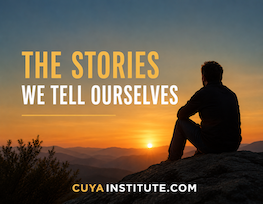
We all have a story we tell ourselves about who we are. I continue to question the stories I tell myself about myself. In my experience, I find myself asking how these stories shape my understanding of where I have been, who I am today, and even what I believe is possible for me tomorrow. I think of these stories as an internal biography made up of where we came from, what happened to us, the people who influenced us, our successes and disappointments, and the choices we made along the way. Our internal stories can become a kind of blueprint for what we allow ourselves to do.
I think it is also helpful to distinguish between the events of our lives and the conclusions we have drawn from them. Self-talk such as “This task is way too complicated,” “Nothing ever works out for me,” or “What if I completely mess up this project?” isn’t really the story itself. These are conclusions that have become attached to our stories, often carrying an emotional weight of their own. Repeat one of these conclusions long enough and it begins to feel less like an interpretation and more like an established fact.
Laura and I have certainly seen this in our own lives. We challenge ourselves to question these stories as they arise. Like everyone else, we have accumulated stories about who we are, what we are good at, what we aren’t good at, and what we think will happen next. Some of those stories have served us well. Others have needed some editing along the way. I suspect that is true for most of us.
I like the word “editing” because it doesn’t mean denying what happened. We don’t need to pretend that difficult experiences weren’t difficult, or replace them with artificial positive thinking. The past deserves honesty. But honesty also means recognizing that an event and the meaning we assign to that event are not necessarily the same thing. Making the distinction between what we hold in our minds as the truth and what is actually happening right now can be enormously important.
This is one reason Laura and I value practices that cultivate greater awareness. Meditation, for example, teaches us to notice thoughts without automatically accepting every thought as an absolute fact. There is an important difference between I am this thought and I am having this thought. That small shift creates some space between the person we are and the story passing through our minds.
Something similar happens through our work at the Cuyamungue Institute. In a Ritual Posture Experience, our ordinary way of organizing and interpreting reality can temporarily loosen. We may encounter ourselves through images, sensations, emotions, symbols, or perspectives that don’t fit neatly into our usual explanations of who we are. In my own experiences, I have found that this can sometimes provide an entirely different vantage point from which to see myself and my life.
Laura and I have also witnessed this in the experiences people have shared with us over the years. The value is not necessarily that an experience provides a new answer or tells us what we should do. Sometimes it is simply the expansiveness of the experience that allows us to recognize that our everyday perspective is not the only perspective available. When the familiar storyline loosens, even briefly, there can be room for something else to emerge.
An embodied experience can also take us beyond the limitations of self-talk alone. We can tell ourselves a more positive story, but words by themselves may not be enough. Through practices that engage the body, awareness, and even moments of transcendence, we have an opportunity not simply to think differently about ourselves, but to experience ourselves differently. Changing our story also means showing up for ourselves consistently, making a different choice, taking a reasonable risk, practicing awareness, forgiving something, or simply being willing to begin again. Little by little, we create new experiences, and those experiences give us new evidence about who we might be.
We are shaped by what has happened to us, and there is no reason to deny or diminish any of it. But we are not required to make the past the final authority on what happens next.
In the world of self-development, with all the practices and tools available to us, perhaps there has never been a better opportunity to become more conscious of the stories we carry and, when necessary, to change them. Not by denying the past, but by allowing our understanding of ourselves to become healthier, more hopeful, and more sustaining.
Our stories matter. We should tell them truthfully and honor where we have been. But every once in a while, I think it is worth asking ourselves: Is the story I am telling about myself still true?



 As a 501(c)(3) nonprofit educational organization, we depend on your support to continue our work. We invite you to join our community and be part of this ongoing journey of exploration and discovery. more….
 The name “CUYA” carries with it both history and vision. Rooted in our origins as the Cuyamungue Institute, it now also serves as an acronym — C.U.Y.A. — a guiding symbol that unites our mission: