Over the years, Laura Lee and I have participated in and facilitated hundreds of Ritual Posture experiences. Much of our attention has naturally been drawn to the postures themselves, the ancient artifacts from which they are derived, the particular positioning of the body, and the remarkable experiences people report. However, going a step further, I find myself equally interested in something that surrounds the posture and gives the entire practice its shape: the ritual structure itself.
What is the role of ritual? Why does preparation matter? These are not simply procedures attached to the practice. There is an intelligence within the sequence.
The more we have explored the relationship between ritual and consciousness through our work at the CUYA Institute, the more I have come to see ritual as one of humanity’s oldest forms of applied intelligence. Ritual carries knowledge through practice. It brings together attention, embodiment, repetition, relationship, timing, transition, and meaning in ways that human beings discovered long before psychology, neuroscience, or consciousness studies existed.
When we hear the word intelligence, we think of analysis, reasoning, problem solving, or the gathering of information. Yet human intelligence has never existed only in the thinking mind. A craftsperson knows how a material will respond through years of touch and repetition. A musician develops an embodied relationship with rhythm that goes far beyond counting beats. People who have lived close to the land learn to recognize subtle patterns in weather, plants, and animals that may be almost invisible to others. Knowledge can be carried through experience long before it is expressed as theory.
Ritual belongs to this kind of knowing. Across cultures and throughout history, people have used rhythm, sound, stillness, bodily positions and movement, music, chanting, silence, symbols, masks, special objects, designated spaces, and shared intention as elements of ritual. Again and again, people discovered that intentionally arranging what we do changes the quality of how we experience ourselves, one another, and the world around us.
One of the first things ritual does is organize attention. It helps center us. Ordinary life continually fragments our awareness as our attention moves from conversation to memory, from responsibilities to worries, and from one interruption to the next. Ritual interrupts this fragmentation and creates a different flow and pattern of participation. The power comes from intention and structure. The ritual communicates that this moment is different and asks us to become present to it.
Laura Lee and I have seen this shift happening before a Ritual Posture session even begins. There may be conversation, laughter, people settling into their places, and newcomers wondering what to expect. Then the ritual structure begins to take form. The room is the same and the people are the same, but the quality of attention changes. The group gradually moves from ordinary social interaction into a shared period of intentional awareness.
Ritual also recognizes something that modern Western culture has sometimes struggled to keep in view: consciousness is embodied. We do not experience life as minds separated from bodies. Every aspect of ritual affects our physiology and participates in our experience of consciousness. Traditional ritual practices have worked with this understanding for thousands of years.
The body is not simply present in ritual. The body participates in creating the experience. In Ritual Postures this principle is central. A specific physical position is intentionally held and maintained while rhythmic sound supports a shift in awareness. With each posture, we change the position of the body in order to explore a change in consciousness.
For me, this is one of ritual’s deepest forms of intelligence. Ritual provides structure at the threshold of the unknown. We see this in the places where ritual appears most often in human life: birth, initiation, partnership, illness, healing, death, grief, seasonal change, spiritual encounter, and major transitions within a community. These are moments when something familiar is ending, something new is beginning, or the future cannot be fully known.
Ritual gives us a way to enter uncertainty with intention and structure. This becomes especially meaningful when ritual is associated with altered or expanded states of consciousness. Entering an experience is only one part of the journey. A well-formed ritual also provides a pathway back into ordinary awareness and an opportunity to integrate what has occurred.
This has become important to Laura Lee and me in thinking about the practice we continue to explore at the CUYA Institute. We often speak about creating a safe container for a Ritual Posture experience. I have come to see the container of ritual itself as one of the central elements in safely exploring altered states of consciousness.
The ritual is part of the technology of the experience. The steps creates consistency without prescribing outcome. Laura Lee and I can facilitate the same posture with a group of people, follow the same basic process, use the same ritual steps, and provide the same instructions, yet each person’s experience remains their own. The ritual establishes the conditions while leaving the content of the experience open.
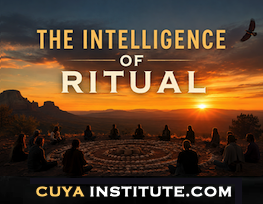
Ritual also carries an intelligence that extends beyond the individual. It brings people into relationship. A circle of people participating in the same process can become something more than a collection of separate individuals. Anyone who has sung with others, danced in a group, joined in prayer, marched in procession, sat around a fire, or participated in a meaningful ceremony has experienced some aspect of this.
The community aspect of ritual matters to us at the Institute because every Ritual Posture experience is both personal and shared. Participants enter together, hear the same rhythm, remain within the experience for the same period, and return together. Then we listen to one another. Sometimes what is shared is extraordinary, and sometimes it is quiet and deeply personal. One person’s experience may unexpectedly resonate with another’s. No one has to agree about what an experience means. The community bears witness, and that act of witnessing is itself part of the ritual container.
Felicitas Goodman entered this territory as both an anthropologist and an mystic. Her work opened a powerful line of inquiry: that some ancient bodily positions may preserve not only artistic or symbolic meaning, but also knowledge about particular ways human beings engaged consciousness. That inquiry remains alive for us today. Laura Lee and I have spent over 30 years involved with this work, and the longer we participate in it, the more intriguing the questions become.
Ritual belongs in that conversation because it brings something distinctive to the study of human consciousness. It brings an accumulated body of practical knowledge about how we enter an altered state of experience, how the body is engaged, how groups are brought together, how thresholds are crossed, how altered states are approached, and how people return and integrate what they have experienced.
This is what we continue to find within the practice of Ritual Postures. The posture itself is essential, but it lives within a larger intelligence. The ritual prepares the ground, creates the container, and establishes the conditions for exploration. Transformation cannot be manufactured, but the conditions that invite it can be cultivated. That is the enduring intelligence of ritual.



 As a 501(c)(3) nonprofit educational organization, we depend on your support to continue our work. We invite you to join our community and be part of this ongoing journey of exploration and discovery. more….
 The name “CUYA” carries with it both history and vision. Rooted in our origins as the Cuyamungue Institute, it now also serves as an acronym — C.U.Y.A. — a guiding symbol that unites our mission: